

Whole House Repipe in Florida: What Does It Look Like Day by Day in a 1980s Palm Coast Slab Home?
- A repipe replaces every supply line in the house at once, through the attic on a slab home, with no floor cut. Four days on a typical three-bath single-story, water on every night.
- This house had polybutylene, copper, two slab leaks in its history, an insurance non-renewal letter, and a homeowner who had put it off for three years.
- The days: main and manifold; attic runs; wall drops and pressure test; inspection, switch-over, drywall. Then the paperwork that got the policy renewed.
- Everything below has its own post: the signs, the copper, the material, the cost, the attic, the insurance, the questions, and the year after.
The situations described here are composites drawn from the types of jobs and decisions we encounter regularly. Names and specific figures are illustrative.
The house was built in 1984 in Palm Coast’s L-section, single story, three bedrooms, two baths, on a slab, and it had every reason a house in this city ends up needing a whole house repipe in Florida: original copper under the slab that had pinholed twice, a bathroom addition in 1991 run in gray polybutylene, and an insurance non-renewal letter that named the polybutylene and gave the homeowner sixty days. She had known about the pipe for three years. The letter is what made it this spring. This guide follows that house from the letter to the renewal, day by day, because every question I get about repiping has an answer somewhere in those four days.
Each part of the job has its own post, linked where it happens. This is the spine.
Before day one: the letter, the walkthrough, and the decision
The letter was a four-point finding. The Citizens Property Insurance[1] four-point form, which most Florida carriers use or copy, has a checkbox for polybutylene, and her inspector had checked it after photographing gray pipe at the water heater. Florida insurers treat PB as a decline because it fails from the inside without warning, a history the Cox v. Shell[2] class action documented and paid for decades ago; the settlement has long closed and the pipe is the homeowner’s problem now. The SB 2-A[3] reforms in 2022 and the follow-on in 2023 made carriers stricter on four-points, and her carrier’s letter was the standard one: repipe within sixty days or the policy lapses. The insurance side, in a house that was sold in the middle of it, is the post on polybutylene pipes and insurance in Florida.
The walkthrough took forty minutes. Year built from the Flagler County Property Appraiser[4], which is what the underwriter had used to flag the house. A gauge on the hose bib: eighty-six pounds, over the eighty the Florida Building Code, Plumbing[5] edition allows, which is part of why the copper had pitted; the piece from her second slab leak, which I had kept, showed the inside pitting the Copper Development Association[6]‘s guidance describes. The polybutylene at the water heater and the 1991 bathroom. Seventeen fixtures. A single-story attic with good access. I marked every drop with painter’s tape so she could see the fourteen rectangles, and I wrote the quote at the kitchen counter.
She had put it off for three years through two slab leaks, which is the pattern in the post on the signs you need to repipe your house. The material was the next conversation: she assumed copper, and the reasons PEX-A won, starting with the piece of her own pipe, are the post on PEX versus copper for a repipe in Florida. The quote, itemized, in the three-bed two-bath PEX range on the service page with the permit at cost, is the shape of the one in the post on how much a repipe costs in Florida. The permit was pulled that week with the rough-in inspection requested for day four.
Day one: the main and the manifold
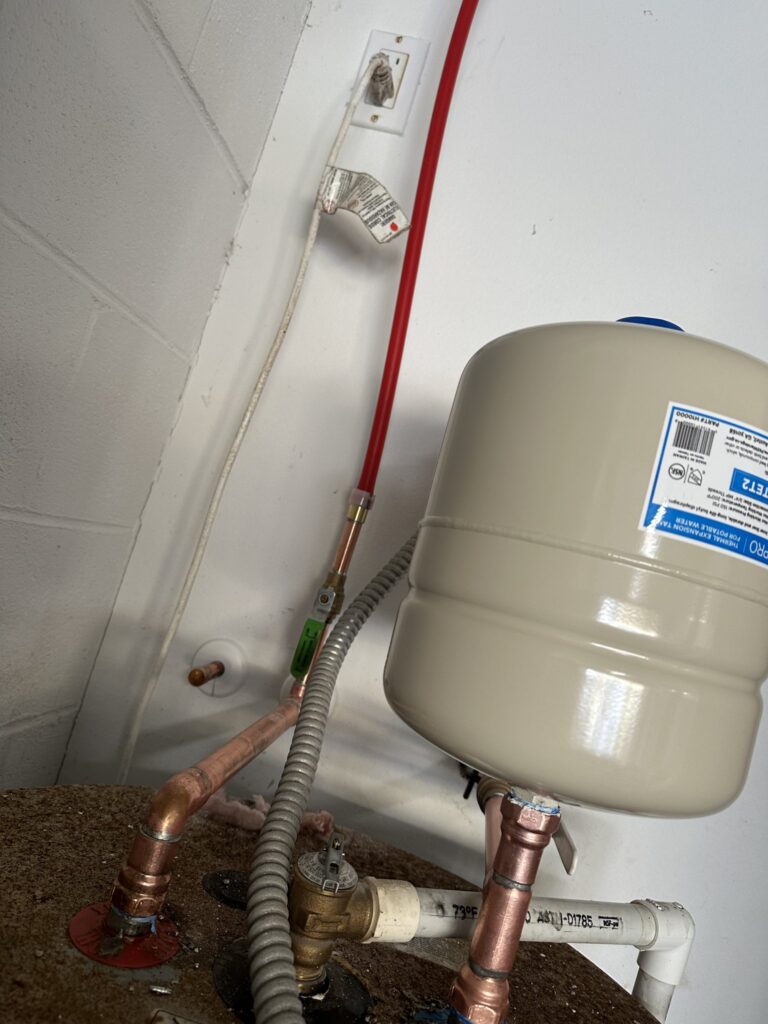
Water off at the meter at seven. The 1984 gate valve at the front stub came out; a new ball valve and a pressure-reducing valve set to sixty went in. In the garage, on the wall beside the water heater, the manifold: a distribution block with thirty labeled valves, one per hot and cold run, fed from the new main. The Plastics Pipe Institute[7]‘s technical data and the manufacturer’s design guidance are the basis for the manifold layout: a continuous run of PEX-A from each valve to its fixture with no joints in the walls or attic. The opening in the garage ceiling above the manifold went in for the runs to reach the attic. The old system stayed live to the house. Water on by four.
Day two: the attic, six to eleven
A Palm Coast attic in May is over a hundred and twenty degrees by noon, so attic hours are six to eleven. The runs came up through the garage ceiling in a bundle and fanned across the trusses, each strapped at the support spacing the Plastics Pipe Institute specifies, hot and cold separated, both insulated because a cold line in a summer attic delivers warm water otherwise. The Florida Building Code, Residential[8] edition governs what can be drilled through a truss, and the routing respected it. By eleven, most of the runs were across the attic and hanging at their drop points. The afternoon was fourteen drywall rectangles cut behind fixtures, on the back side of walls where possible. Water on, still on the old lines. The attic, day by day and hour by hour, is the post on a repipe through the attic in a slab house.
Day three: the drops and the pressure test
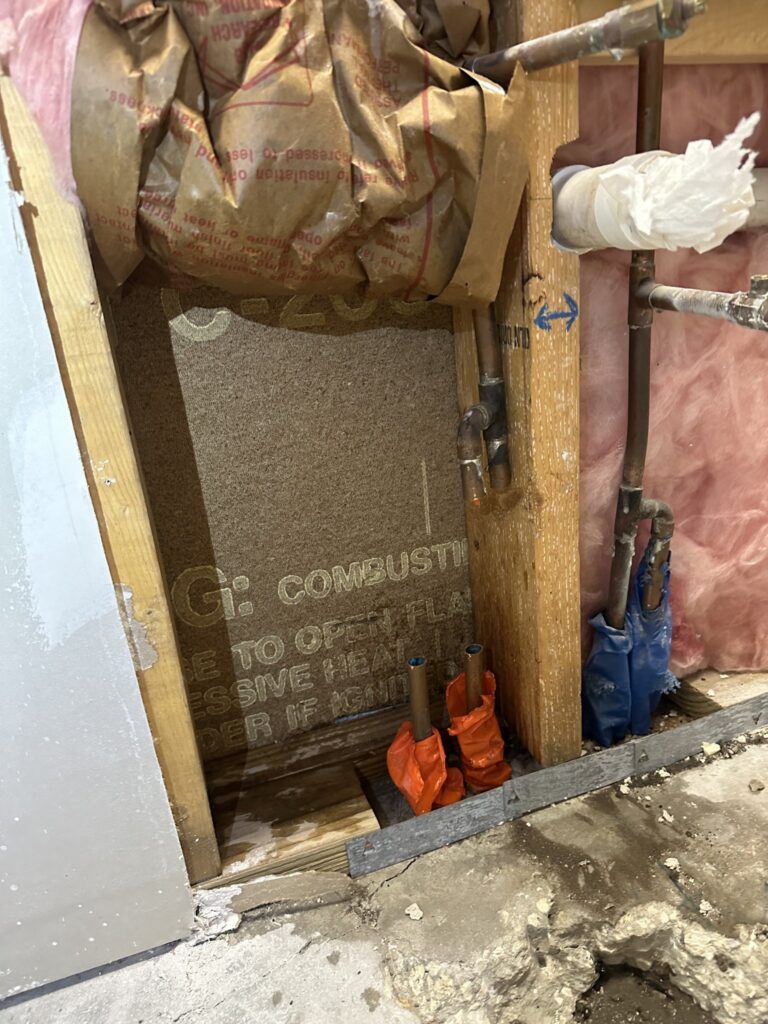
The remaining runs across the attic in the morning. Then every drop fished down its wall to the opening behind the fixture and terminated on a new stub-out with a quarter-turn stop, beside the old stub-out, which was still live. Two new frost-free hose bibs on new runs. New connections at the water heater, the last foot in copper, valved both sides. By evening, every run terminated, every stop closed, and the new system holding air at a hundred pounds on a gauge at the manifold. The polybutylene in the 1991 bathroom wall came out in pieces through the opening; it was brittle enough to snap by hand, which is what the insurers have been reading about for thirty years. Water on, on the old lines, for the last night.

Day four: the inspection, the switch, the walls
The City of Palm Coast Building Division[9] inspector arrived at eight, walked the attic with a light, checked strapping, insulation, and truss penetrations, read the gauge at the manifold, looked at the main and the PRV, and signed the rough-in. Then the switch: water off, every old stop closed and cut, the old copper and PB capped at each stub and drained at the lowest point, the new stops opened, the manifold valves opened one at a time, and the house filled and purged from the farthest fixture back. An hour. The afternoon was drywall: fourteen rectangles patched, taped, and mudded to paint-ready, and an access panel instead of a patch at the garage ceiling. Water on that night on the new system at sixty pounds, with the old pipe drained and dry in the sand where it will stay.
The week after: the final, the painter, and the paperwork
The final inspection the following Tuesday, after the fixtures had run for a few days: the inspector ran taps and flushed toilets and closed the permit. The painter the day after. And the package to the carrier: the permit number and the city’s inspection record, an invoice on letterhead stating that all polybutylene and copper supply piping in the residence had been replaced with PEX-A, with the fixture count and the date, and labeled photos of the manifold, the main and PRV, the water heater connections, and three fixture stops. The carrier renewed on that package without a second four-point, which is common when it is complete. The invoice language is the part that matters; an invoice that says plumbing work does nothing for an underwriter. Sixty days was the deadline. The renewal came at day nineteen.
What every question about repiping has an answer for, in that house
Do the floors get cut? No. The runs went through the attic and down the walls; the old pipe stayed capped in the sand.
How long does it take? Four days, water on every night, the final and painter the week after.
What material? PEX-A with a manifold, for the water that had pitted the copper, the attic heat, the price of copper this year, and the design; copper for the last foot at the heater. The full argument is the PEX-versus-copper post above.
What does it cost? The three-bed two-bath PEX range on the service page, permit at cost, drywall to paint-ready as a line. What lower bids leave out is the cost post above.
How many holes? Fourteen, plus the garage ceiling, all patched. Invisible under paint a year later.
What about the old pipe? Drained, capped, abandoned. It cannot leak with no water in it.
What does the insurer need? The permit, the inspection record, an invoice that names the material replaced, and photos. The package above.
What if I hired the wrong company? The house I fixed six months after someone else’s unpermitted, unsupported, manifold-less repipe is the post on the questions to ask a repipe plumber before you sign, and the six questions there are the ones that would have prevented it.
What was not in the four days, and why
A few things people expect in a repipe that were not part of this one, on purpose. The drain lines were not touched; a repipe is the supply side, the pressurized water coming in, and the drains are gravity PVC and cast iron that are a separate system with a separate life. Hers were sound on a camera pass and stayed. The water heater was not replaced; it was eight years old and fine, and it got new connections and an expansion tank rather than a new tank. The fixtures were not replaced; every faucet and toilet went back on new stops and new supply lines. And the slab was not opened anywhere, because there was no reason to reach the old pipe once it was drained and capped. A repipe quote that includes drains, a heater, or fixtures is a bigger job than a repipe, and sometimes the right one, but it should be listed as what it is. Hers was seventeen fixtures, one main, one manifold, and four days, and the invoice says exactly that.
What the homeowner did during the four days
Less than people expect. She cleared the area under every sink and moved furniture a foot off the walls where the tape was, the night before day one. She kept the water heater breaker on, because the heater stayed connected the whole time, and she ran the dishwasher and laundry on days one through three as usual, since the old system was live every evening. On day four she was out of the house for the hour of the switch-over, which was her choice and not a requirement. The one thing I ask every repipe customer to do is pick a paint color for the patches before day four, so the painter can be booked for the week after and the walls are not primer-white for a month. She had. The other thing I ask, which is harder, is to not run the irrigation on the mornings the main is off; the controller was set to skip those days, and the lawn did not notice.
What the copper looked like, for the record
I keep the pieces. Hers, from the second slab leak two years before, was half-inch Type M, and cut lengthwise it showed the pitting from the inside that every piece of 1980s Palm Coast copper I have cut shows: rounded craters under a thin deposit, a dozen to the six inches, one of them through. The Copper Development Association attributes it to water chemistry, velocity, and time, and the City of Palm Coast Annual Water Quality Report[10]‘s numbers are the chemistry. That piece is the post on pinhole leaks in copper pipes in Florida. It is also the reason the new pipe is not copper.
One hurricane season later
I went back the next spring. Sixty on the gauge at the front bib. Thirty labels on the manifold, legible. The expansion tank on the heater, which a closed system with a PRV requires, holding its air charge, the relief line dry. Fourteen patches invisible under a raking light. And a card inside the garage door with the hurricane shutdown: heater breaker off, main closed, bib valves at the manifold closed. She had used it in September for a storm that missed, in about two minutes. The pipe had needed nothing. That visit is the post on what to expect after a repipe one hurricane season later.
What people ask about repiping, in one place
What is a whole house repipe? Replacing every supply line in the house at once, from the main to every fixture, with new pipe run through the attic on a slab home.
When do I need one? A pattern of leaks on the same material, polybutylene anywhere, pitted copper, or an insurance letter that names any of them.
PEX or copper? PEX-A with a manifold on Palm Coast water, for most houses. Copper where sunlight, rodents, or preference say so.
How long, and do I lose water? Four days on a three-bath single-story, and water every night.
What does it cost? The service page ranges, by house size and material, plus the permit at cost. The itemized quote is the document; compare bids line by line.
What the house is now
A 1984 slab home with no copper and no polybutylene carrying water, a manifold on the garage wall, sixty pounds at every tap, a closed permit, a renewed policy, and a card by the door. The three years she waited cost her two slab leaks and a claim. The four days cost what the quote said. That is what a repipe is: the last supply-line bill the house will have, done in four days with the water on every night, and the paperwork that proves it.
If a letter or a leak has you reading about a whole house repipe in Florida, the walkthrough is where it starts: a gauge, a look at the water heater connections, and tape on the walls where the openings will be. Our whole house repipe service in Palm Coast does it under the $96 service call, applies it to the work, itemizes every line, and sends the carrier the package that closes the finding.
Sources
- Citizens Property Insurance Corporation: four-point inspection form
- Cox v. Shell Oil polybutylene class action settlement record
- Florida Senate Bill 2-A (2022) and SB 7052 (2023): property insurance reforms
- Flagler County Property Appraiser
- Florida Building Code, Plumbing (8th Edition, 2023), Florida Building Commission
- Copper Development Association: pitting corrosion of copper tube
- Plastics Pipe Institute: PEX-A technical and installation data
- Florida Building Code, Residential (8th Edition, 2023), Florida Building Commission
- City of Palm Coast Building Division: permits and inspections
- City of Palm Coast Annual Water Quality Report (Consumer Confidence Report)