

Why Do Pinhole Leaks in Copper Pipes Happen in Florida, and What Did the Cut-Out Section From a Palm Coast Garage Show?
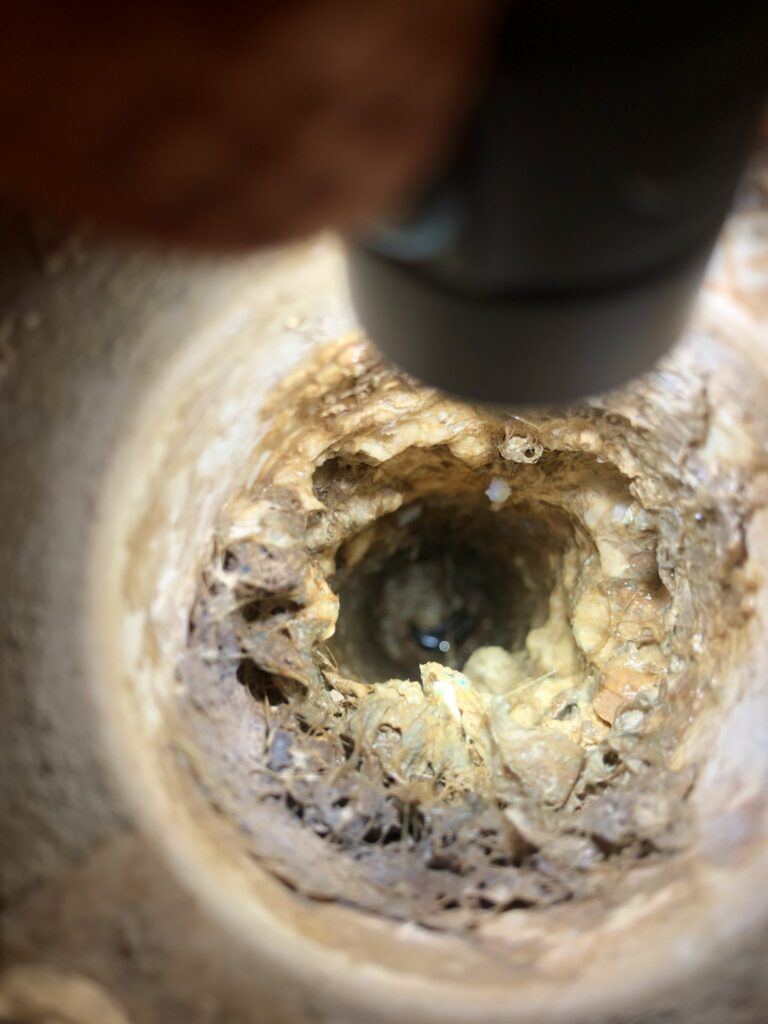
- A pinhole is the one pit out of dozens that finished going through. The cut-out piece shows the rest, and they are the reason a spot repair is a bet.
- Palm Coast copper pits from the inside: hard, slightly aggressive water, chloramine, and high velocity in undersized lines. The Hammock adds salt air on the outside.
- Type M thin-wall copper from the 1990s has less metal to lose than Type L. It pinholes sooner.
- The pressure reading on the first visit is part of the diagnosis. This house was running high, which speeds every pit.
The situations described here are composites drawn from the types of jobs and decisions we encounter regularly. Names and specific figures are illustrative.
The stain was on the garage wall below the water heater, a blue-green streak a foot long with a wet spot at the bottom, and the homeowner had noticed it because the cardboard boxes stacked against the wall had gone soft. He had heard that pinhole leaks in copper pipes were a Florida thing and wanted to know whether that was true, why, and whether the six-inch piece I was about to cut out was the end of it or the beginning. I cut it out, capped the line, and we looked at the piece together under the garage light. It was the beginning.
This post is that piece of pipe, read the way I read it for him: what the inside looked like, the four things that made it look that way, and the decision it forced between a coupling and a repipe.
What the cut-out section showed
Half-inch copper, about six inches, with a pinhole you could barely see from the outside and a green crust around it. Cut lengthwise, the inside was the story: a dozen small craters across the six inches, most a fraction of the way through the wall, one all the way. The pits were rounded, with a thin layer of deposit over each one and a rough, blue-green surface between them. That is pitting corrosion, and the Copper Development Association[1]‘s guidance on it describes exactly this appearance: localized attack from the water side that concentrates at a point and eats down rather than across. The wall between the pits was intact. The pipe had not thinned; it had been drilled from the inside in a dozen places at once, and one of the drills had finished.

The six inches I cut out came from a run that was twenty feet long, from a house full of the same copper installed the same year. The other nineteen and a half feet, and every other run in the house, had the same dozen pits per six inches, at the same stage. That is the sentence that decides whether this is a repair or a repipe, and it is the sentence I said with the piece in my hand.
Cause one: the water
Palm Coast city water is about eleven grains hard, per the City of Palm Coast Annual Water Quality Report[2], and it is disinfected with chloramine. Hard water alone does not pit copper; it tends to lay down a protective scale. What pits copper is water with a chemistry that keeps that scale from forming evenly, so the surface is protected in most places and exposed in a few, and the exposed points become the pits. The specifics vary with pH, dissolved oxygen, chlorides, and the disinfectant, and chloramine’s role is debated but it is on the list of things the research points at. The practical version for a homeowner: Palm Coast water, over decades, pits copper, and the report’s numbers are why.
Cause two: velocity
Water moving fast through copper scours the protective layer off the inside of the pipe at bends and fittings, and pits start where the layer is gone. Velocity is high when pipe is undersized for the flow or when pressure is high. I put a gauge on the hose bib at the first visit and read eighty-five pounds, which is above the eighty the Florida Building Code, Plumbing[3] edition sets as the maximum for a residence and well above the sixty or so I like to see. High pressure means every faucet opening drives water faster through the same half-inch copper, and the pits cluster at the elbows near the water heater and at the first fittings off the main, which is exactly where the garage stain was. A pressure-reducing valve at the main is a repair on its own, and on a house keeping its copper it is the first thing I install; on this house it went in with the repipe.
Cause three: the pipe itself
Copper tube comes in wall thicknesses: Type K is the heaviest, Type L is what the code and most plumbers specify for supply lines, and Type M is the thinnest, legal in many residential applications and cheaper by the foot. A lot of 1990s production construction in Palm Coast used Type M for supply because it passed and it saved money. The stamp on the cut-out piece said Type M. A pit that would take fifteen years to get through Type L gets through Type M sooner, because there is less wall to eat. This is not a defect; it is a choice the builder made in 1994 that came due in the garage.
Cause four: the outside, in the Hammock
The house is a mile from the ocean, and NOAA and Florida Sea Grant[4]‘s material on salt aerosol corrosion near the coast describes what happens to exposed metal there: salt settles, holds moisture, and corrodes from the outside. The copper in this garage was exposed, uninsulated, on an exterior wall, and its outside surface had the dull, mottled green of coastal copper. That is not what made the pinhole, which was from the inside. But it is a second attack on the same wall of metal, and in the Hammock it is worth naming, because a repipe material that does not corrode in salt air is one of the arguments for what replaced this copper.
The decision: coupling or repipe
A spot repair is a coupling and six inches of new copper, and it is correct for one pinhole on copper that is otherwise sound. It is a bet on copper that has a dozen pits per six inches everywhere else. The bet usually loses within a year or two, somewhere else in the house, and the second loss is often under the slab, where the repair is a reroute and the water damage is a claim. I laid it out plainly: the coupling today, and a list of the runs most likely to go next, which is any elbow near the heater and anything under the kitchen. Or a repipe, which retires all of it. He asked how many pinholes I had seen turn into a repipe within two years. Most of them. The pattern, across a house that repaired three before deciding, is the post on the signs you need to repipe your house.
He chose the repipe, and PEX-A rather than new copper, for the reasons in the post on PEX versus copper for a repipe in Florida: the same water would pit new copper the same way, the attic route avoids the slab, and the Plastics Pipe Institute[5]‘s technical data on PEX-A covers its resistance to exactly the water chemistry that had drilled his garage line. The pressure-reducing valve went in at the main on the first day.
What people ask holding the piece
Why do copper pipes get pinhole leaks? Pitting corrosion from the inside, driven by water chemistry, high velocity, thin-wall tube, and time. Salt air adds attack from outside near the coast.
Is one pinhole a sign of more? Almost always. The cut-out piece shows the rest at the same stage.
Can pinholes be repaired? Yes, with a coupling. It fixes that pit and none of the others.
Does high water pressure cause pinholes? It speeds them. Anything over eighty pounds is over code; a pressure-reducing valve is the fix.
Will new copper pinhole too? On the same water, at the same pressure, eventually yes. That is the argument for PEX.
The whole four days that replaced this copper, in a different house with the same pits, is the whole house repipe in Florida told day by day in a 1980s Palm Coast slab home.
What is on the garage wall now
A patched and painted section of drywall, a manifold with labeled PEX runs, a pressure-reducing valve holding the house at sixty, and no copper anywhere it could stain anything. The six-inch piece is in my shop, cut lengthwise, and I show it to every customer with a green streak on a wall. It has settled more repipe decisions than any quote.
If you have a green stain and are reading about pinhole leaks in copper pipes, the answer is in the piece that comes out, and I will cut it lengthwise so you can see it. Our whole house repipe service in Palm Coast reads it with you under the $96 service call, takes the pressure reading, and applies the $96 to the coupling or the repipe, whichever the pipe calls for.
Sources
- Copper Development Association: pitting corrosion of copper tube
- City of Palm Coast Annual Water Quality Report (Consumer Confidence Report)
- Florida Building Code, Plumbing (8th Edition, 2023), Florida Building Commission
- NOAA / Florida Sea Grant: salt aerosol and coastal corrosion
- Plastics Pipe Institute: PEX-A technical and installation data