

Whole House Water Filtration System Guide for Palm Coast: What Happens When It Starts With a Glass of Tap Water?
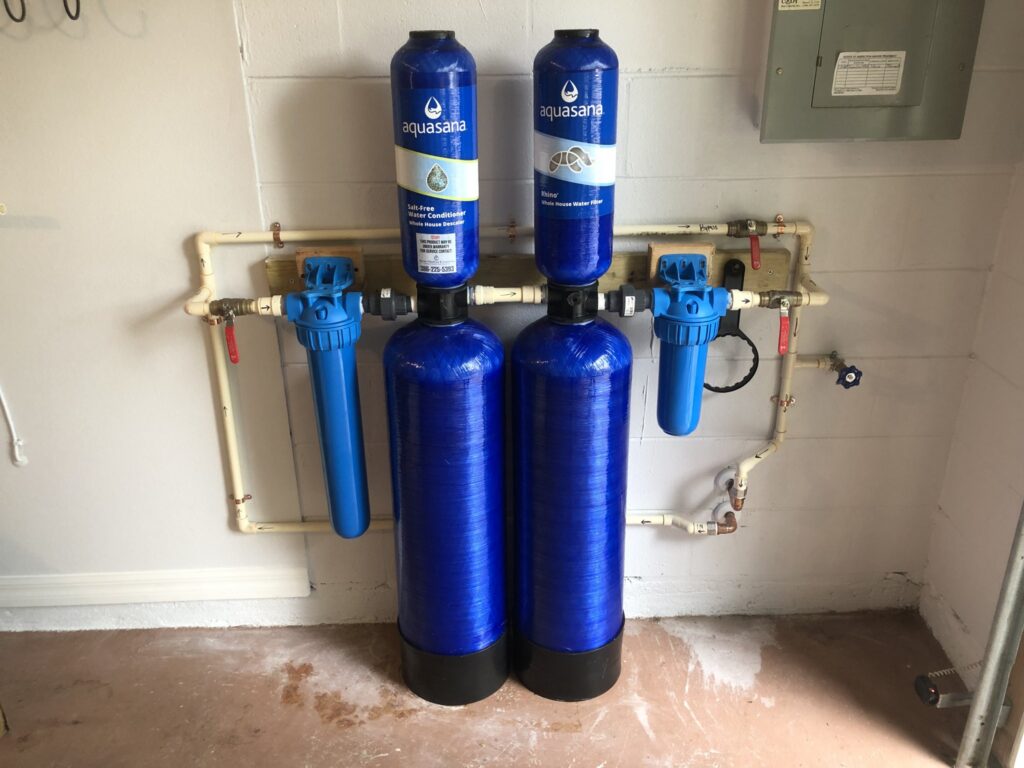
- Palm Coast city water is about eleven grains hard and disinfected with chloramine. Wells west of the city add iron and sulfur. Those four things are the whole problem set, and each has its own fix.
- A carbon filter removes chloramine. A softener removes hardness. Aeration and an oxidizing filter remove iron and sulfur. None of them does another’s job.
- Three households, three tests, three different systems: two tanks for the family, three for the well, one for the Hammock couple.
- Every system starts with a test. On city water a strip and the city’s report; on a well, a lab.
The situations described here are composites drawn from the types of jobs and decisions we encounter regularly. Names and specific figures are illustrative.
Every water conversation I have starts the same way: a glass of tap water on the kitchen counter, a hardness strip dipped in it, and a second strip for chlorine and chloramine, while the city’s water quality report loads on my phone. Five minutes, and the homeowner and I are looking at the same numbers. This whole house water filtration system guide is built the way those conversations go: the numbers first, then three households whose numbers pointed three different directions, so that the categories of equipment get explained by watching them get chosen rather than by a catalog.
Each household has its own post, linked where it belongs, along with the posts on cost, maintenance, and the two comparisons people ask about most. This is the spine.
The glass of water: what is in it
Palm Coast municipal water comes from wells into the Floridan Aquifer, which is limestone, and it arrives at the tap with about eleven grains per gallon of hardness, which the City of Palm Coast Annual Water Quality Report[1] publishes and the USGS classification[2] rates as hard to very hard. That is calcium and magnesium, dissolved from the rock, and it is the white on the shower door and the crust on the heater element. The city disinfects with chloramine, a chlorine-ammonia compound that the American Water Works Association[3]‘s fact sheets describe as more persistent than chlorine, which is the swimming-pool smell in the shower and the taste at the tap; the City of Palm Coast Utility Department[4] publishes a notice about it. Everything else on the report is a regulated contaminant below its limit, which is the reassuring part and the part that does not change what a homeowner buys.
West of I-95, in Bunnell and Flagler Estates, houses are on private wells into the same rock, and the water adds two things: dissolved iron, which stains laundry and toilets orange, and hydrogen sulfide, which smells like rotten eggs at the hot tap. UF/IFAS Extension’s home water quality series[5] covers all four problems, and the Florida DEP’s private well guidance[6] covers the testing a well needs beyond a strip. Those four things, hardness, chloramine, iron, and sulfide, are the entire problem set in this county. Every system I install is some combination of four answers.
The four answers, in one paragraph each
A carbon filter. A tank of activated carbon, catalytic for chloramine, on the main line, treating every tap. It removes chlorine and chloramine taste and odor and is certified under NSF/ANSI[7] 42, with NSF/ANSI 53 listings for specific contaminants depending on the media. It does nothing for hardness. The one I install most is the post on an Aquasana Rhino review from the plumber who installed one.

A softener. An ion-exchange tank that swaps sodium for calcium and magnesium, regenerated with salt brine to a drain, certified under NSF/ANSI 44. It removes hardness and every visible symptom of it. It does nothing for chloramine, iron, or sulfide. What it costs, line by line, is the post on what a water softener costs in Florida installed in a Palm Coast garage.
A salt-free conditioner. Not a softener: it crystallizes hardness so it scales less inside pipes and heaters, but the water tests as hard after it as before and the shower door stays white on this water. The house that learned that in six months is the post on water softener versus salt-free conditioner.
Aeration and an oxidizing filter. For wells only: air injection gasses off sulfide and oxidizes iron to particles, and a catalytic media tank traps them and backwashes them to a drain. It goes ahead of a softener on any well with iron, because iron fouls resin. Two wells that needed it are the posts on why well water smells like rotten eggs in Florida and the well water treatment system that worked after two failed.
Plus, at the kitchen sink only, an under-sink reverse osmosis unit, NSF/ANSI 58, for drinking water: it removes dissolved solids and the sodium a softener adds, at one tap. Many houses with a whole-house system add one; a house that only cares about drinking water sometimes needs only that. The Water Quality Association[8]‘s consumer guidance is the clearest neutral reference for what each of these categories is certified to do.
Household one: the city-water family, softener versus conditioner, then both tanks
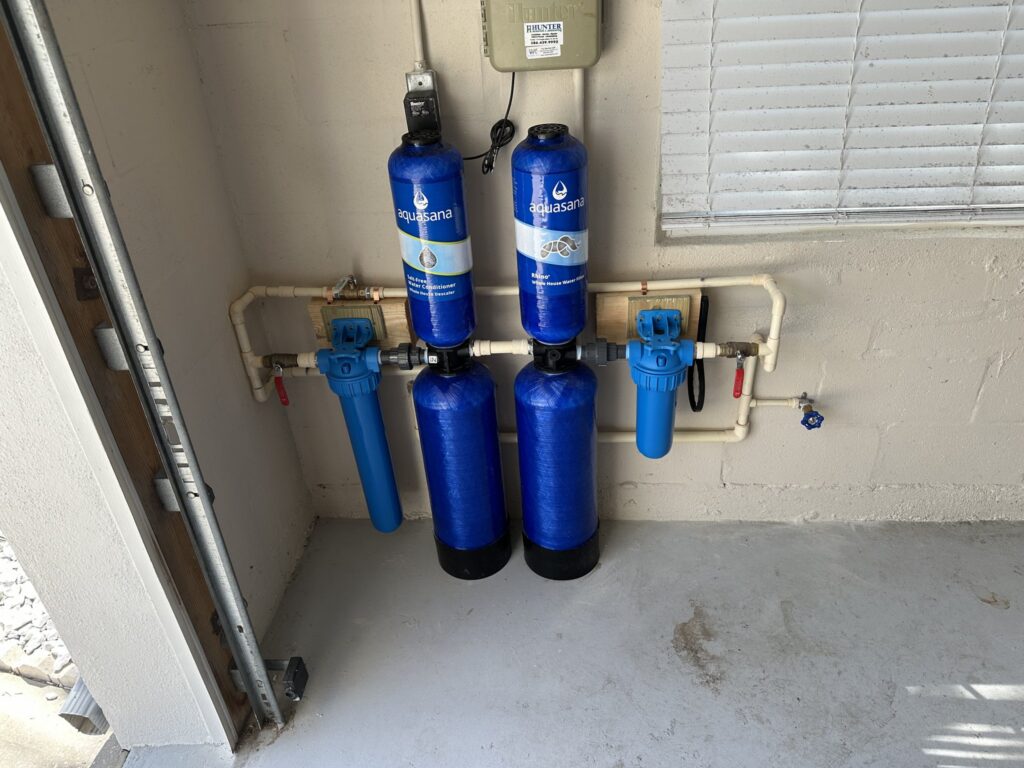
A family of four in Seminole Woods, on city water, with a newborn. The strip read eleven grains. The chloramine test read positive. Their complaints were the two that go with those two numbers: the pool smell in the bath water, and the crust on the bottle warmer and the white on the shower door. The husband had nearly bought a salt-free conditioner on a friend’s advice and I explained, with the strip, why it would not clear the door on this water. The question they actually needed answered was whether they needed a filter or a softener, and the answer was both: carbon first, to remove the chloramine and protect the softener’s resin from it, softener second, to remove the hardness. Two tanks on the garage wall next to the water heater, a sediment pre-filter ahead of both, a bypass around the train, and the irrigation teed off upstream so the sprinklers run on raw water and the softener does not spend salt on the lawn. One day. The reasoning is the post on whole house water filter versus water softener in Palm Coast. A bag and a half of salt a month, a pre-filter every two to three months, and a bath that smells like a bath.
Household two: the Bunnell well, three tanks in order
A family on acreage west of Bunnell, on a well. No strip for this one; I filled lab bottles at the well head, because a well’s problems are the ones a strip does not measure. The report: hydrogen sulfide at a level that smells, iron at a level that stains, fourteen grains of hardness, slightly acidic pH, no bacteria. That is the most common well profile in the county and it is a three-problem well. A softener alone, which a big-box associate had recommended, would have fouled with iron in a year and done nothing for the smell; I have pulled two of those out of Flagler Estates garages. The design was a train: aeration to gas off the sulfide and oxidize the iron, a catalytic oxidizing filter sized to the iron load to trap it and backwash it nightly, and the softener last, seeing only hardness. Three tanks, a vent for the sulfide, a backwash drain, a bypass, the irrigation ahead of all of it. A day and a half. The first white load of laundry came three days later. Every well system gets sized from a lab report, and the yearly bacteria test the Florida Department of Health[9] recommends through the Flagler County Health Department is on the same visit as the yearly system check.
Household three: the Hammock couple, who only wanted the taste
A retired couple in the Hammock, on city water, who did not care about the shower door and did not want a brine tank or a salt delivery. Their complaint was one thing: the water tasted like a pool and so did the coffee. Eleven grains on the strip, chloramine positive, same as the family in Seminole Woods. Different answer, because the complaint was different. A single catalytic carbon tank on the main with a pre-filter and a bypass, and an under-sink RO at the kitchen for drinking water and the coffee maker. No softener. They manage the hardness the way most Palm Coast houses do, with a squeegee, vinegar on the aerators, and a yearly heater flush, and they are fine with that. Half a day. The taste was gone the first evening. If they call in a year about the shower door, the softener goes downstream of the carbon tank in an afternoon, and the loop is already built for it.
Three households, the same county, the same rock, and three different garages. The difference was never the equipment catalog; it was the test and the complaint.
How to read your own glass
On city water: a hardness strip from the hardware store at the cold kitchen tap, and the City of Palm Coast Annual Water Quality Report on the city’s website for the hardness figure and the disinfectant. That is enough to choose between a carbon tank, a softener, or both. The full walk through what eleven grains does in a house, room by room, is the post on whether Palm Coast water is hard and what the city’s report says.
On a well: a certified lab test from samples at the well head, for hydrogen sulfide, iron, manganese, hardness, pH, and bacteria. Nothing gets sized without it. A strip on a well tells you the hardness and hides the two things that decide the design.
Then the complaint, in the homeowner’s words. Smell and taste point at carbon. Scale, spots, and soap point at a softener. Orange stains and rotten eggs point at a well train. Drinking water only points at RO. Most Palm Coast houses have two of those, and the system is two tanks.
What every system needs regardless
A sediment pre-filter in a clear housing ahead of everything, because the mains carry sediment and scale flakes and a well pumps sand, and the cartridge is the cheap part that protects the expensive parts. Unions on every tank so it comes out without cutting pipe. A bypass around the train so the house has water when anything is being serviced. The irrigation teed off upstream. A drain with an air gap for anything that regenerates or backwashes. A permit from the City of Palm Coast Building Division[10] for the main tie-in and the drain, billed at cost. And a mounting board on the garage wall next to the water heater, which is where the main comes in on most Palm Coast houses and where every one of these systems wants to live.
The mistakes I undo most
Four of them, in the order I see them. A softener on a well with iron, which fouls its resin inside two years and is the graveyard tank in half the Flagler Estates garages I visit. A salt-free conditioner bought as a softener, which protects the heater and leaves the shower door exactly as white as before; the buyer is usually someone whose friend in another city with softer water loves theirs. A carbon tank installed with no bypass and no pre-filter, which turns a five-minute cartridge change into a water-off ordeal and lets sediment into a bed rated for a decade. And a timer-based softener regenerating every other night on a fixed schedule, which uses two to three times the salt a metered valve would on the same water and is the single most common thing I adjust on systems other people installed. None of the four is a bad product. All four are the right product in the wrong place, or the right product installed without the parts around it that make it serviceable, and each one traces back to a system chosen before the water was tested.
What it costs, and what it costs to keep
The service page lists the installed ranges for a whole-house carbon filter, a softener, a conditioner add-on, a well pre-treatment stage, and an under-sink RO, and the two-tank and three-tank installs cost less than the sum of their parts because the pre-filter, bypass, loop, drain, permit, and labor day are shared. Ongoing: a pre-filter cartridge every two to three months on city water, sooner on a well; salt monthly for a softener; RO filters yearly and a membrane every three to five; a carbon tank rebed around a decade out; oxidizing media every several years on a well. The schedule, built from a customer who saved a year of pre-filters and laid them on the garage floor, is the post on how often to change a whole house water filter in Palm Coast.
What people ask with the glass in front of them
Do I need a whole house water filter in Palm Coast? If the smell or taste bothers you, a carbon filter fixes it. If it does not, you do not.
Filter or softener? Smell and taste, filter. Scale and spots, softener. Both, both, carbon first.
What about a well? A lab test, then aeration, an oxidizing filter, and a softener in that order if the report shows iron, sulfide, and hardness together.
Is a salt-free conditioner a softener? No. It reduces scale inside pipes. It does not clear a shower door on this water.
What is the first step? A strip and the city’s report on city water. A lab test on a well. Then the complaint.
What the three garages have in common
A board on the wall by the water heater, a clear pre-filter housing, a bypass, an irrigation tee upstream, and a test result taped above it all. Beyond that they have almost nothing in common, because the water in the glass and the complaint in the kitchen were different in each house. That is the guide: test first, name the complaint, and buy the answer to that complaint and not the tank that was on sale.
If you want this whole house water filtration system guide applied to your own glass of water, the strip and the report take five minutes. Our whole house water filtration service in Palm Coast and Flagler County does the test under the $96 service call, applies it to the install, and builds the system the numbers call for, whether that is one tank, two, or three.
Sources
- City of Palm Coast Annual Water Quality Report (Consumer Confidence Report)
- USGS Water Science School: Hardness of Water
- American Water Works Association: chloramine fact sheets
- City of Palm Coast Utility Department: chloramine notice and water source
- UF/IFAS Extension (EDIS): Home Water Quality series
- Florida DEP: private well guidance
- NSF/ANSI 42, 44, 53 and 58 drinking water treatment standards
- Water Quality Association: consumer guidance
- Florida Department of Health: private well testing (Flagler County Health Department)
- City of Palm Coast Building Division: permits