

Water Softener vs Salt-Free Conditioner: Which One Fixed the White Shower Door in a Palm Coast Home?
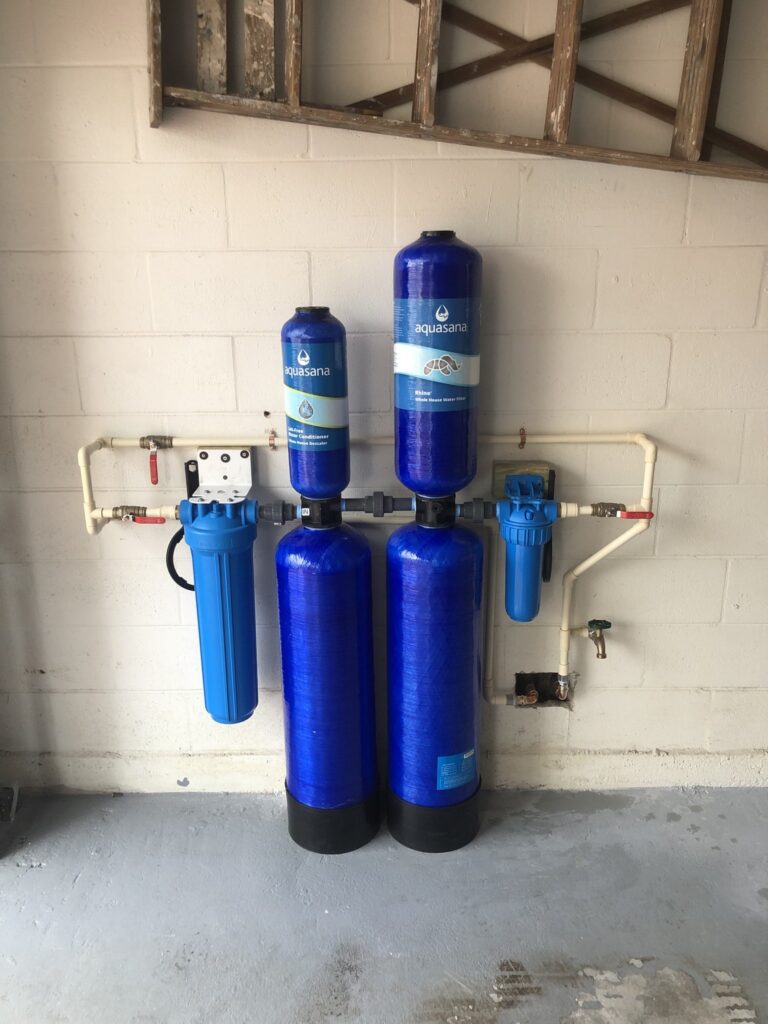
- A salt-free conditioner does not remove hardness. It changes how the calcium crystallizes so it scales less inside pipes and heaters. The water tests exactly as hard after it as before.
- A softener removes the hardness. Glass stays clear, soap lathers, the heater element stays clean. It uses salt and sends brine to a drain.
- On eleven-grain Palm Coast water, a conditioner alone does not fix a white shower door. This homeowner learned that in six months.
- The conditioner was not wasted; it now protects the heater on the irrigation-bypassed loop. The softener does the rest.
The situations described here are composites drawn from the types of jobs and decisions we encounter regularly. Names and specific figures are illustrative.
He had done the research and made a reasonable decision. A friend in Jacksonville had a salt-free conditioner and loved it, the marketing said no salt, no drain, no maintenance, and it was cheaper. He installed one himself in the garage. Six months later the shower door was as white as before, the kettle had the same crust, and the dishwasher glasses had the same spots, and he called me to ask what he had done wrong. Nothing, except believe that water softener vs salt-free conditioner was a comparison between two ways of doing the same thing. It is not. They do different things, and on this water only one of them does the thing he wanted.
This post is that house, with what each device actually does, why the conditioner did not clear the door, what the softener did, and the two questions about salt that everyone asks.
What a salt-free conditioner does
Most salt-free conditioners sold for homes use a media called template-assisted crystallization, or TAC. Water passes over ceramic beads that cause dissolved calcium and magnesium to form tiny, stable crystals that stay suspended in the water instead of bonding to surfaces. The minerals are still there, in the same quantity; they have changed form. The claim, which is real and tested, is reduced scale formation inside pipes, on heater elements, and in appliances, because the crystals pass through rather than plating out. The Water Quality Association[1]‘s consumer guidance is careful about the language here: a conditioner reduces scale; it does not soften. A hardness test on the outlet of a conditioner reads the same as the inlet. His did: eleven grains in, eleven grains out.
What that means in a house: the heater element scales slower, the pipes stay cleaner, and the dishwasher’s internal parts see less buildup. But the water that dries on a shower door still leaves calcium behind, because the crystals dry there too. Soap still reacts with the minerals and forms curd. Glasses still spot. The visible, daily symptoms of hard water, the ones that made him buy something, are not what a conditioner addresses. The invisible, long-term ones are.
What a softener does
A softener is an ion-exchange tank. Resin beads charged with sodium ions swap them for calcium and magnesium ions as water passes through, so the water leaving the tank has almost none of the minerals that cause hardness. Periodically the resin is regenerated by flushing it with a salt brine from the attached brine tank, which recharges the beads with sodium and sends the collected calcium and magnesium to a drain. The output tests at zero to one grain. NSF/ANSI[2] 44 is the certification standard for cation-exchange softeners and it is on the label of every unit worth buying.

In a house: the shower door stays clear because there is nothing in the water to leave behind. Soap lathers with less product. The heater element stays clean. Glasses come out of the dishwasher without spots and without rinse aid. Towels soften. Every symptom on the list in the post on whether Palm Coast water is hard goes away. The trade is a bag or two of salt a month, a drain connection for the brine, and a small amount of sodium added to the water.
Why the conditioner did not fix the door
Because it was never going to. On soft-to-moderate water, say four to six grains, a conditioner’s scale reduction can be enough that the visible symptoms are mild and people are happy. On eleven grains, which is what the City of Palm Coast Annual Water Quality Report[3] shows and what the USGS classification[4] calls very hard at the top of the range, there is too much mineral for crystal form to matter on a glass door. He had bought scale protection for his water heater, which is a fine thing to own, and expected it to be a softener. The friend in Jacksonville is on a different utility with different water; that is the whole difference.
The install, and what happened to the conditioner
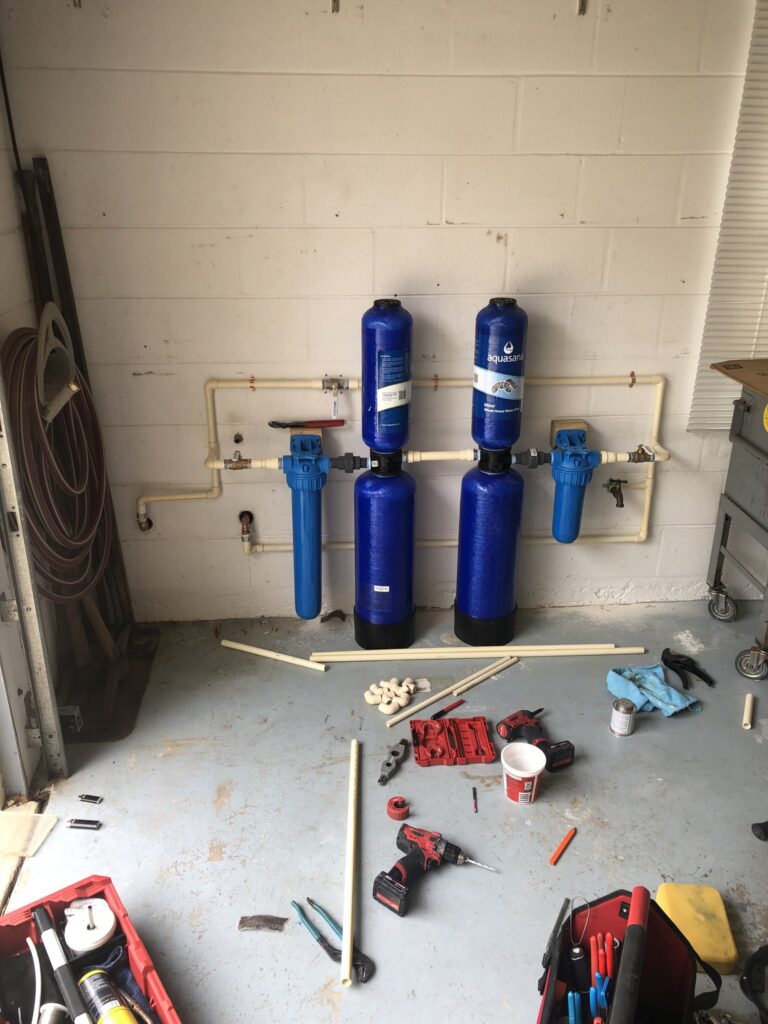
A metered softener sized for eleven grains and a family of four, on the main after the sediment pre-filter, with a bypass valve so the house can run unsoftened if needed. A drain line for the brine to the garage utility sink standpipe. And the detail people forget: the irrigation tee moved upstream of the softener, so the lawn gets raw water and the softener does not spend salt on the sprinklers. That change alone cut his projected salt use in half. The conditioner stayed, downstream, feeding the water heater loop; a conditioner after a softener is belt and suspenders, but it was already paid for and it costs nothing to run, so it stayed as insurance on the heater. The whole visit was a half day. The itemized version of a softener install, line by line with the salt math, is the post on what a water softener costs in Florida installed in a Palm Coast garage.
The two salt questions
Sodium in the water. A softener adds roughly eight milligrams of sodium per liter for every grain of hardness removed, so eleven grains of Palm Coast water picks up about ninety milligrams per liter, which is less than a slice of bread in a glass and well under what most low-sodium diets track. People on strict sodium restriction can use potassium chloride in the brine tank instead of sodium chloride, at higher cost, or keep an unsoftened tap for drinking. Most people run a reverse osmosis unit at the kitchen sink for drinking water anyway, which removes the sodium along with everything else.
Salt in the septic. Brine discharge from a softener regenerating into a septic system is a question I get on every well and septic house, and UF/IFAS Extension’s home water quality series[5] addresses it: modern metered softeners that regenerate on demand rather than on a timer discharge far less brine than the old timer units, and the research on septic drainfield effects is mixed at typical residential volumes. Florida DEP’s septic guidance[6] does not prohibit it. I install metered units, set them to regenerate as rarely as the hardness allows, and route the brine to a drain that does not sit over the drainfield when the layout permits. On city sewer, which this house was on, it is simply not an issue.
When I recommend each one
Softener: any Palm Coast house on city water where the homeowner wants the visible symptoms gone. That is most of them. Conditioner alone: a house on moderate water, a house where salt or a drain is impossible, or a house where the only goal is protecting the heater and the homeowner is fine with the door. Both: a house with a softener that also wants extra heater protection, or a house where the softener is bypassed for some fixtures and the conditioner covers those. Neither addresses the chloramine smell; that is a carbon filter, and the house that needed both a filter and a softener is the post on whole house water filter versus water softener in Palm Coast.
What people ask when the first one did not work
Does a salt-free conditioner soften water? No. It reduces scale formation. The water tests as hard after it as before.
Will a conditioner fix spots on my shower door? On Palm Coast water, no. A softener will.
Is softened water safe to drink? Yes. The sodium added is small; potassium chloride or an RO tap are options for people who track sodium closely.
Can I use a softener on septic? Yes, with a metered unit and sensible drain routing. It is common on Flagler wells.
Do I need both? Usually not. A softener does the visible work. A conditioner is heater protection that a softener already provides.
Which of the three households in the whole house water filtration system guide this one most resembles, and why the Bunnell well in the post on why well water smells like rotten eggs in Florida needed neither of these first, is the difference between city water and a well.
What the door looks like now
Clear, and it has stayed clear. He uses about a bag and a half of salt a month with the irrigation bypassed. The conditioner sits quietly ahead of the heater doing what it was always good at. The friend in Jacksonville still loves his, and on his water he should.
If you are weighing water softener vs salt-free conditioner for a Palm Coast house, the first question is what you want to stop seeing, and on eleven grains the answer to a white shower door is a softener. Our whole house water filtration service in Palm Coast tests the water under the $96 service call, applies it to the install, and will tell you plainly if the cheaper device is the wrong one for your water.
Sources
- Water Quality Association: consumer guidance
- NSF/ANSI 42, 44, 53 and 58 drinking water treatment standards
- City of Palm Coast Annual Water Quality Report (Consumer Confidence Report)
- USGS Water Science School: Hardness of Water
- UF/IFAS Extension (EDIS): Home Water Quality series
- Florida DEP: private well guidance