

Whole House Water Filter vs Water Softener: Does a Palm Coast Home Need One, the Other, or Both?
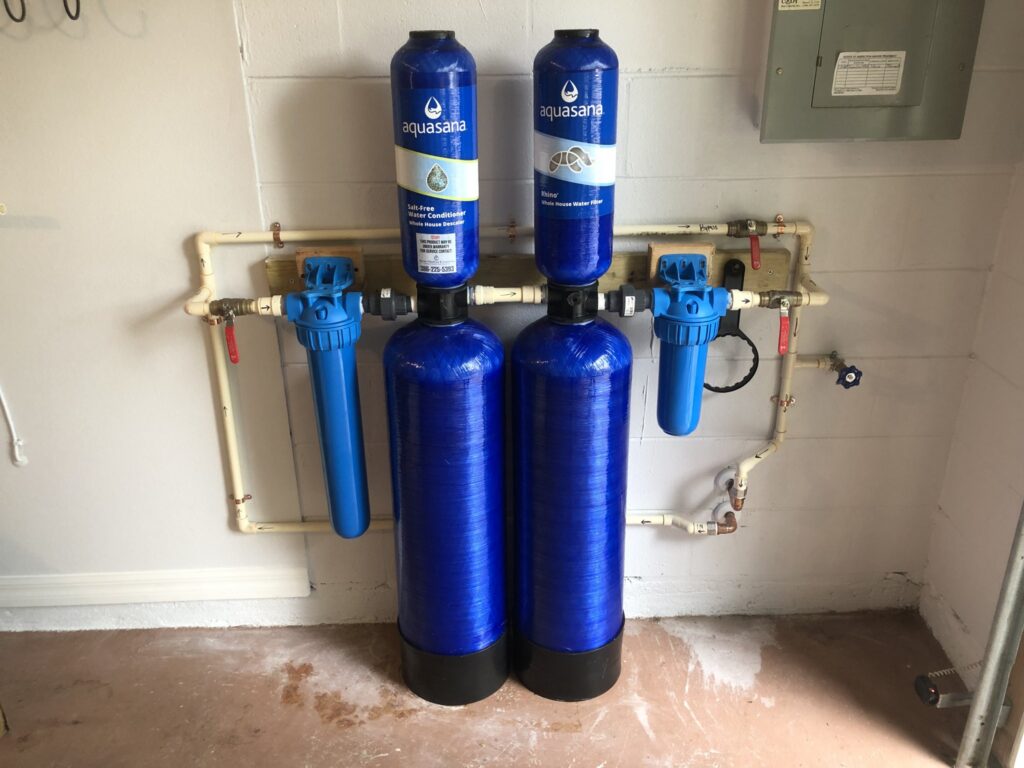
- A filter and a softener solve different problems. Carbon removes chloramine, taste, and odor. A softener removes hardness. Palm Coast water has both.
- One tank cannot do both jobs. A softener passes chloramine straight through; a carbon filter passes hardness straight through.
- The order matters: carbon first, softener second, so the resin is protected from the disinfectant.
- They chose both. It cost more than one and less than two separate installs, and the baby’s bath water is what they were paying for.
The situations described here are composites drawn from the types of jobs and decisions we encounter regularly. Names and specific figures are illustrative.
They had a three-week-old and two complaints that arrived at the same time. The bath water smelled like a swimming pool, which the pediatrician had said was fine but which they did not want on a newborn’s skin, and the bottle warmer and the kettle had a white crust after a month. They had looked at systems online and could not tell what did what, and the question they asked me was the right one: whole house water filter vs water softener, and which one fixes which complaint? The answer was that each fixes one, and they had two.
This post is that garage: what each tank does, why one cannot do the other’s job, the order they go in, where they fit, what both cost against one, and what they chose.
The pool smell: chloramine
Palm Coast disinfects its water with chloramine, a compound of chlorine and ammonia, and the City of Palm Coast Utility Department[1] publishes a notice about it because it is not the same as chlorine. It is more stable, which is why the utility uses it, and it does not dissipate if you let water sit the way chlorine does. The American Water Works Association[2]‘s chloramine fact sheets explain the tradeoff: better residual disinfection through the distribution system, with a persistent taste and odor at the tap and a known tendency to degrade rubber parts like toilet flapper seals and faucet washers over time. The smell in a warm bath is the chloramine gassing off. It is safe. It is also the thing they wanted gone.
The device that removes chloramine is a carbon filter, and specifically catalytic carbon, which is activated carbon treated to break the chloramine bond. Standard activated carbon handles chlorine well and chloramine poorly; catalytic carbon handles both. A whole-house carbon tank sits on the main line and treats every tap. It is certified under NSF/ANSI[3] 42 for taste and odor reduction and, depending on the media, NSF/ANSI 53 for specific contaminants. A softener does nothing for chloramine. The water leaving a softener smells exactly like the water entering it.
The crust: hardness
The white on the bottle warmer is calcium from eleven-grain water, which the City of Palm Coast Annual Water Quality Report[4] publishes and which is the subject of the post on whether Palm Coast water is hard. The device that removes it is an ion-exchange softener, certified under NSF/ANSI 44. A carbon filter does nothing for hardness. Water leaving a carbon tank is exactly as hard as water entering it, and the crust on the kettle would be identical. The difference between a softener and the salt-free conditioner they had also seen advertised is the post on water softener versus salt-free conditioner; the short version is that a conditioner would not have cleared the bottle warmer either.
Why one tank cannot do both
People ask whether a combination unit exists, and there are products marketed that way: a single tank with layered media, carbon on top of resin. They exist and I do not install them, for two reasons. The media beds have different service lives and different regeneration needs, and a combined tank has to be serviced on the shorter schedule, which wastes the longer one. And the carbon layer in a combined tank is too thin to handle chloramine at whole-house flow rates; it is sized for a chlorine touch-up, not a chloramine removal. The Water Quality Association[5]‘s consumer guidance treats the two functions as separate categories with separate certifications, and that is how I design them: two tanks, each doing its job, each replaceable on its own schedule.
The order, and why
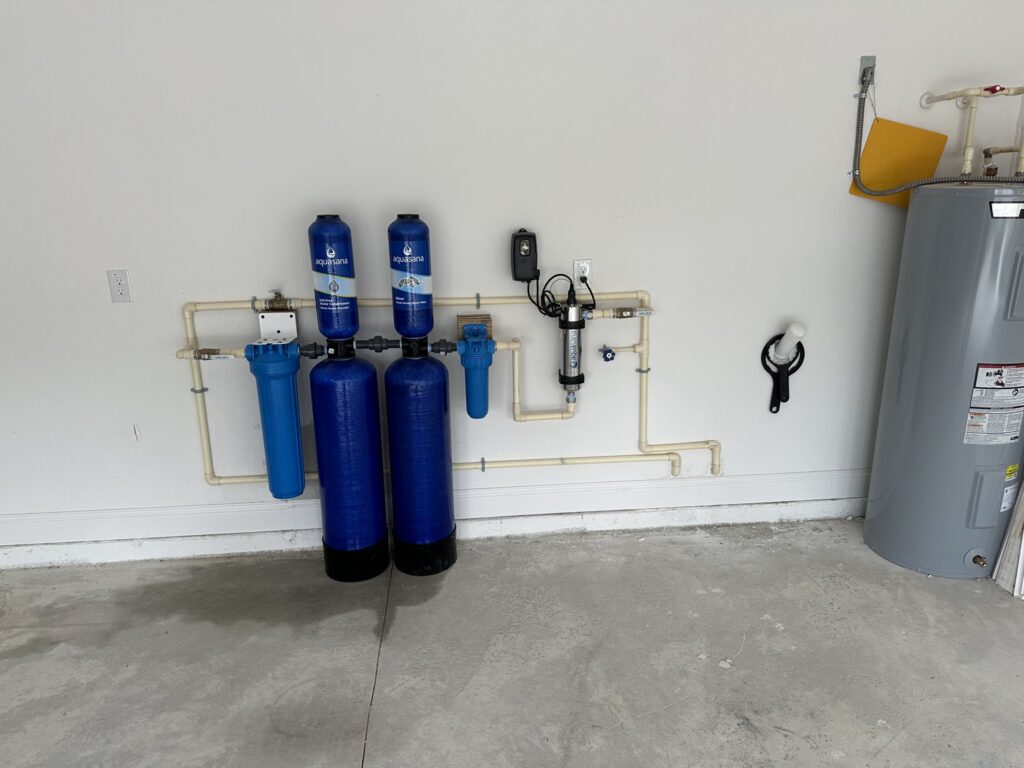
Carbon first, softener second. Chloramine attacks softener resin over years, slowly oxidizing the beads and shortening their life. Putting the carbon tank ahead of the softener means the resin sees water with the disinfectant already removed, and the softener lasts longer. It also means the carbon tank takes the sediment first, so a sediment pre-filter goes ahead of both. The sequence on the wall: main shut-off, sediment pre-filter, carbon tank, softener, then the house. Irrigation tees off before the pre-filter. A bypass around the whole train so the house has water if any tank is being serviced.

The garage, and where two tanks fit
Two tanks plus a brine tank plus a pre-filter housing takes about four feet of wall and a foot and a half of depth, which is the width of a water heater closet or the end of a garage wall. Their garage had the water heater on the back wall with the main coming in beside it, which is the common Palm Coast layout and the easy one: the train goes on a board next to the heater, the brine tank on the floor beneath, the drain to the utility sink. I have installed two-tank trains in tighter spaces, including one that went outside on a wall under a small roof, but a garage wall next to the heater is the layout I hope for.
What both cost against one
The carbon tank installed is in the range the service page lists for a whole-house filter. The softener installed is in the range it lists for a softener. Both together, in one visit, cost less than the sum, because the pre-filter, the bypass, the main tie-in, the drain, and the labor day are shared; the second tank is mostly the tank. Ongoing: the carbon media lasts years and is replaced as a tank rebed; the softener uses salt monthly; the pre-filter cartridge changes every few months, and that schedule, built from a year of saved cartridges, is the post on how often to change a whole house water filter. The line-by-line for a softener install, including the salt math, is the post on what a water softener costs in Florida in a Palm Coast garage.
What they chose
Both. The chloramine was the reason they called and the carbon tank was never in question. The softener they debated, because it was the larger ongoing cost and the crust on the kettle was an annoyance rather than a concern. What decided it was the bath water again: soft water rinses soap off skin more completely, and a newborn with dry patches was the tiebreaker. Catalytic carbon tank, metered softener sized for three people with room for more, pre-filter, bypass, irrigation tee moved. One day in the garage. A specific whole-house filter I install often, and what it does and does not do on this water, is the post on an Aquasana Rhino review from the plumber who installed one.
What people ask standing in the garage
What is the difference between a water filter and a water softener? A filter removes contaminants, taste, and odor. A softener removes hardness. Different jobs.
Do I need a filter or a softener? If the complaint is smell or taste, a carbon filter. If it is scale, spots, and soap, a softener. Palm Coast water has both, so many houses want both.
Can one system do both? Not well. Combined tanks compromise both functions. Two tanks in the right order is the design.
Which goes first? Carbon, then softener. The carbon protects the resin from chloramine.
Does a softener remove chlorine? No. And a carbon filter does not remove hardness.
The three households that ended at three different systems, of which this couple is the city-water one that needed both, are the spine of the whole house water filtration system guide that starts with a glass of Palm Coast tap water.
What the bath smells like now
Like a bath. The bottle warmer has been clean for a year. They use about a bag of salt a month. The carbon tank will be rebedded in a few years and will not need anything before then. Two tanks, two jobs, one wall.
If you are comparing a whole house water filter vs water softener and the house has both a smell and a crust, the honest answer may be both, in the right order. Our whole house water filtration service in Palm Coast tests for both under the $96 service call, applies it to the install, and builds the train so each tank does the job it is certified for.
Sources
- City of Palm Coast Utility Department: chloramine notice and water source
- American Water Works Association: chloramine fact sheets
- NSF/ANSI 42, 44, 53 and 58 drinking water treatment standards
- City of Palm Coast Annual Water Quality Report (Consumer Confidence Report)
- Water Quality Association: consumer guidance