

What Well Water Treatment System in Florida Actually Worked on a Flagler Estates Well After Two Others Failed?
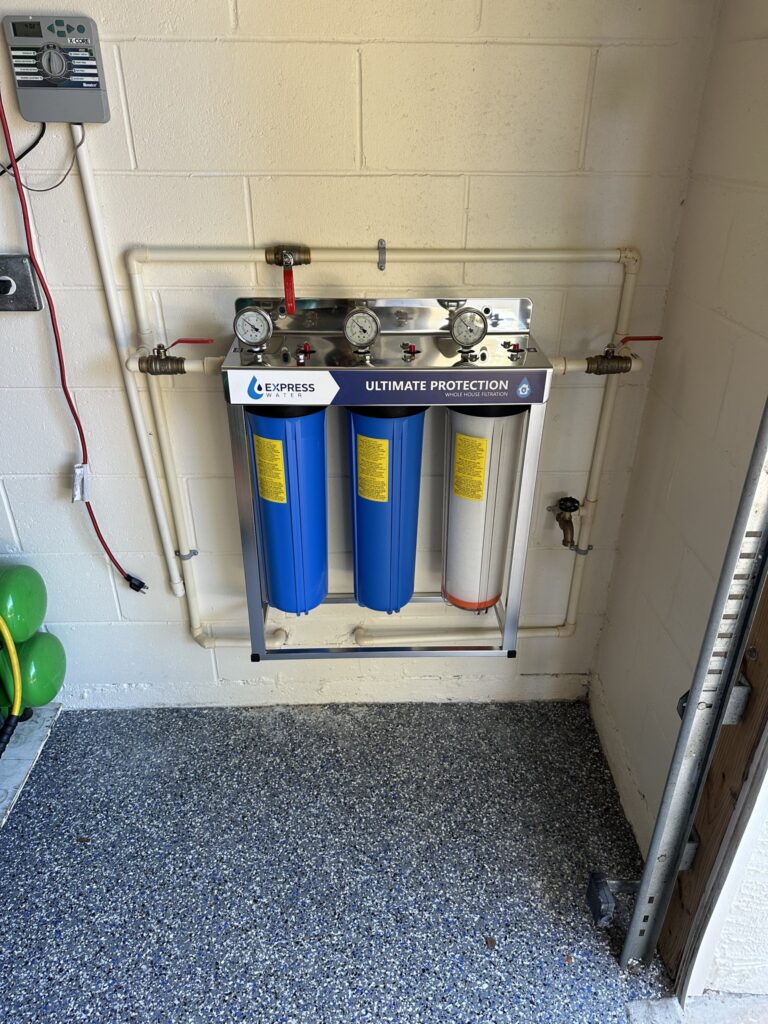
- Two single-tank systems failed on this well because a single tank cannot treat iron, sulfide, and hardness at once. Each one was overwhelmed by the problem it was not built for.
- No well system gets sized without a lab test. Strips do not measure the things that decide the design.
- The train that worked: aeration to oxidize, a catalytic filter to trap, a softener last. Three tanks, three jobs, in that order.
- Six months in, the backwash runs clear, the softener resin is clean, and the water tests where the design said it would.
The situations described here are composites drawn from the types of jobs and decisions we encounter regularly. Names and specific figures are illustrative.
The garage in Flagler Estates had a graveyard: a disconnected softener from a big-box store with orange resin visible through the tank, and a single-tank iron filter from a different store that had lasted eighteen months before the water went back to smelling and staining. The homeowner had spent real money twice and was ready to spend it a third time, but he wanted to understand first why a well water treatment system in Florida had failed him twice on a well his neighbors seemed to live with. The answer was in the two dead tanks, and it was the same answer both times.
This post is the third system: what the lab said, why each earlier tank failed against those numbers, the train I built, and the six-month check that told us it was holding.
Why the first system failed: a softener alone
The first system had been a softener. On a well with dissolved iron, the resin grabs iron along with calcium and magnesium, and iron does not rinse out with a brine regeneration the way hardness does. It builds on the beads until the softener is a rust-coated tank that neither softens nor filters. The orange resin in the dead tank was the whole story. UF/IFAS Extension’s home water quality series[1] has a fact sheet on iron in well water that makes the point plainly: a softener can handle a trace of iron, and beyond that it needs iron removal ahead of it. This well was well beyond a trace. The softener had lasted about two years before the water was worse than before it went in, and it had done nothing for the sulfur smell at any point, because a softener does not touch hydrogen sulfide.
Why the second system failed: a single-tank iron filter
The second system was an improvement in concept: an iron filter with an oxidizing media, the kind that traps iron and sulfide as they pass through. The problem was that it was one tank, sized for the iron alone, asked to handle iron, sulfide, and the load of a household on a well with both. Oxidizing media has a capacity, and it needs either an air charge or a chemical feed to keep oxidizing; the big-box unit used a small air pocket that the well’s sulfide exhausted in weeks between backwashes. The media loaded with iron faster than the backwash could clear it, channeled, and passed water through untreated. Eighteen months. And it had no softener behind it, so even when it was working the hardness went straight through and the kettle stayed crusted. Two systems, each doing part of the job, each failing at the part it was not built for.
The lab report, which nobody had run
Neither store had tested the water beyond a strip. I pulled samples at the well head and sent them to a certified lab, which is the rule I do not break on a well: the Florida DEP’s private well guidance[2] and the Florida Department of Health[3]‘s well testing guidance through the Flagler County Health Department both say the same thing about what to test, and the results are what a system is sized from. This well: iron high, hydrogen sulfide moderate, hardness around sixteen grains, manganese present, pH slightly acidic, bacteria absent. That is a three-problem well, and it needs a three-stage answer. The Bunnell well in the post on why well water smells like rotten eggs in Florida had a similar profile at lower levels; this one was the heavier version.
The train: three tanks, in order
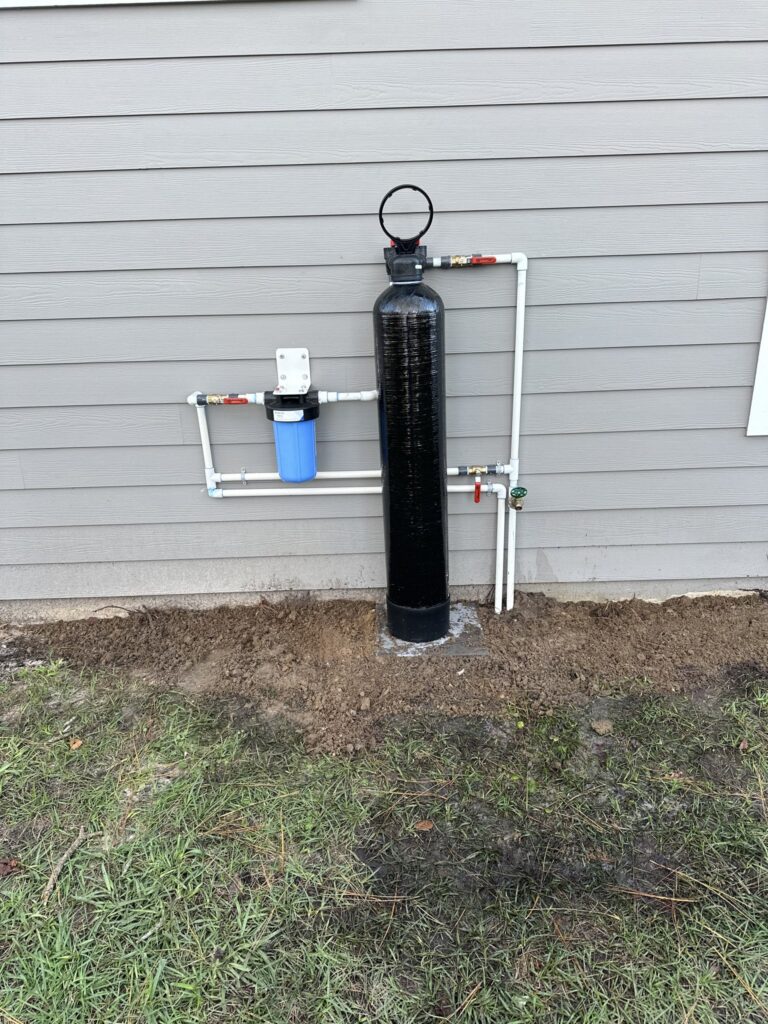
Stage one, aeration. An air-injection system ahead of everything: a venturi draws air into the water on the pump’s pressure and holds it in a contact tank, where sulfide gasses off through a vent and dissolved iron oxidizes to particles. This is the stage the single-tank filter was missing. Oxidizing before the filter means the filter traps particles instead of trying to do the chemistry itself.

Stage two, a catalytic oxidizing filter sized for the iron load, with a media suited to the slightly acidic pH. It traps the oxidized iron and manganese and finishes any sulfide that survived the contact tank, and it backwashes nightly to a dedicated drain, flushing the rust out. Sized larger than the dead one by a good margin, because the lab number said so.
Stage three, the softener, last. With iron and sulfide gone, it sees only hardness, which is what NSF/ANSI[4] 44 certifies it for, and it lasts. Sixteen grains and a family of three sized to a specific capacity with a metered valve. Bypass around the whole train, irrigation teed off ahead of it, a sediment pre-filter first of all because the well pumps sand. The Water Quality Association[5]‘s consumer guidance describes this sequence as the standard treatment train for iron-and-sulfide wells, and every component carries its NSF/ANSI listing for its function.
Two days in the garage, including a new backwash drain and the power for the contact tank. The dead tanks went to the curb.
What it cost against what he had already spent
More than either of the two earlier systems, and less than the two of them combined. That is usually the shape of it: the right train costs more than a single tank because it is three tanks, and it costs less than buying single tanks twice and having neither work. The well version of a quote is more lines than the city version in the post on what a water softener costs in Florida installed in a Palm Coast garage, and the difference is the lab report driving each line.
The six-month check
The check I make on any well train: the backwash water from the oxidizing filter, caught in a bucket at the drain during a manual cycle, ran clear, which means the media is not overloaded. The softener’s resin, viewed through the tank port, was white, not orange, which means the iron is being stopped ahead of it. The salt use was where I predicted. And a strip at the kitchen tap read under one grain with no smell at the hot tap. I also pulled a follow-up sample for the lab, which came back with iron and sulfide below detection and hardness at one grain. He keeps that report next to the first one on the garage wall. What a year of pre-filters looks like on a well like this, with the cartridge going brown faster than on city water, is the post on how often to change a whole house water filter.
What people on failed systems ask
Why did my well water system stop working? Usually because one tank was asked to do two or three jobs. Iron fouls softeners; sulfide exhausts iron filters; hardness passes through both.
What is the best well water treatment system in Florida? The one sized from a lab report. For iron, sulfide, and hardness together, that is aeration, an oxidizing filter, and a softener, in that order.
Can I skip the lab test? Not on a well. Strips do not measure iron, sulfide, pH, or bacteria, and those decide the design.
How long does a well treatment system last? Media in an oxidizing filter, several years with proper backwash. Softener resin, a decade or more once iron is kept off it. The dead systems here lasted two years and eighteen months because they were the wrong systems.
Does it need maintenance? A sediment pre-filter every couple of months, salt monthly, a backwash check and a lab test yearly.
The Bunnell well, the Flagler Estates well, and the city-water households that needed different things entirely are all in the whole house water filtration system guide that starts with a glass of Palm Coast tap water.
What the garage looks like now
Three tanks on a board, a contact tank with a vent through the wall, a brine bin, a pre-filter housing, and two lab reports taped above them. No graveyard. The water smells like nothing and the whites are white, which is what the first two systems had promised.
If you are on your second or third well water treatment system in Florida and the water is back to smelling, the lab report is the thing that has been missing. Our whole house water filtration service in Palm Coast and Flagler County pulls the samples under the $96 service call, applies it to the install, and builds the train the numbers call for instead of the tank that was on sale.