

Why Did a Four-Point Inspection Water Heater Check Fail a Working Tank in Flagler County?
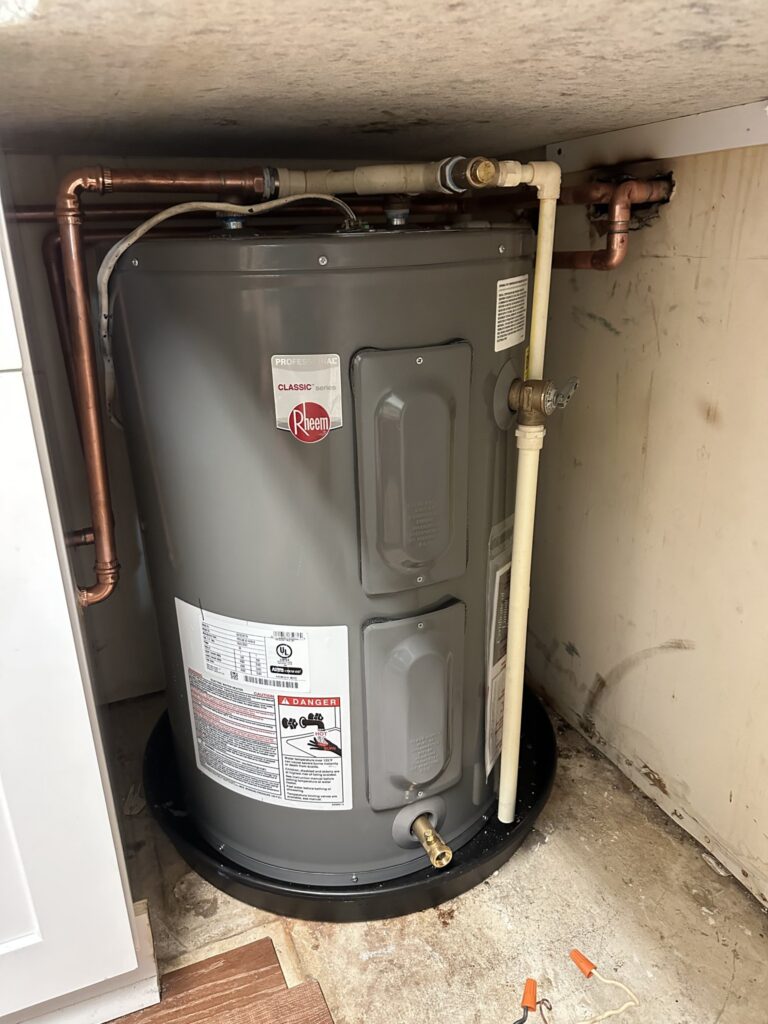
- A four-point inspection is not a plumbing inspection. It is an insurer’s risk snapshot, and a working water heater can fail it on age, pan, expansion tank, and the T&P line alone.
- The letter gave 30 days. The permit, the install, and the re-inspection photos took eleven.
- What inspectors in Flagler flag versus what they note: age over 15, no pan under an interior tank, corroded T&P discharge, no expansion tank on a closed system.
- The fix is a permitted replacement with the paperwork the underwriter wants. The paperwork is half the job.
The situations described here are composites drawn from the types of jobs and decisions we encounter regularly. Names and specific figures are illustrative.
The letter arrived in a Palm Coast mailbox in the L-section in early spring: the policy was up for renewal, a four-point inspection water heater finding had come back, and the underwriter wanted the tank addressed within 30 days or the renewal would not bind. The couple who called me had lived in the house since 2009, the tank had been installed the year they bought it, and it had never given them a day of trouble. It was making hot water that morning. It failed anyway. That is the part that confuses people, and it is the part this post is about.
Here is what the inspector flagged, what was actually wrong, what was cosmetic, and how the eleven days went from the letter to the re-inspection.
What a four-point inspection is actually for
A four-point inspection looks at roof, electrical, HVAC, and plumbing, and it exists so an insurer can decide whether to write or renew a policy on an older home. The Citizens Property Insurance four-point form[1], in its 2023 revision, is the one most Flagler County homeowners see, and other carriers use forms modeled on it. The Florida Office of Insurance Regulation[2] publishes consumer guidance explaining that the inspection is a risk snapshot, not a code inspection. The distinction matters: a water heater can be perfectly safe and still be a risk the underwriter does not want, because a fifteen-year-old tank on a slab with no pan is a water-damage claim waiting to be filed, and the reforms in Florida’s SB 2-A[3] and SB 7052[4] made insurers considerably less willing to carry that risk.
The plumbing section of the form asks for the water heater’s age, its type, whether it shows corrosion or leaks, and it has space for photos. Inspectors in this county are consistent about what they photograph: the rating plate, the base of the tank and the pan, the T&P discharge line, and the supply connections. Those four photos decided this couple’s finding.
What the inspector’s photos showed
The couple forwarded me the report. The tank was a 40-gallon electric, and the rating plate decoded to 2009, which put it at fifteen years and change. Fifteen is the number most underwriters use as a hard line for a tank, in my experience, and a few use twelve. That alone would have drawn the finding. But the photos showed three more things.
No pan. The tank sat directly on the garage slab, which is how it was installed in 2009 and how most Palm Coast tanks of that era were installed. No expansion tank. The house had a pressure-reducing valve at the main, which makes it a closed system, and the T&P valve had a green crust at the outlet from years of weeping. And the T&P discharge line was a corroded galvanized nipple with a short piece of copper that ended two feet above the floor, which is not where the manufacturer’s manual or the Florida Building Code, Plumbing edition[5], say it should end.
The inspector had written each of these on the form. The age was the reason for the finding. The other three were the reasons the underwriter did not offer a conditional renewal. I have seen underwriters let a fourteen-year tank ride for a year when everything around it is right. This one had nothing around it right.
What was cosmetic, and what was not
The couple wanted to know whether a cheaper fix would do. Could we add a pan, an expansion tank, and a new T&P line and keep the tank? I have done that on tanks at ten or twelve years when the anode has life left and the seam is clean, and I explain how I make that call in the post on whether to repair or replace a water heater. On this tank, I pulled the anode and it was bare wire. The seam had a rust bloom at the back where the wall hid it. And the number was fifteen. Even with everything else fixed, the underwriter’s line was the age, and no inspector was going to write a clean report on a fifteen-year tank with a rusted seam.
The green crust on the T&P valve was cosmetic in the sense that a new valve fixes it, but it was the symptom that mattered most, because it told me the expansion tank had been missing for fifteen years and the T&P had been doing the expansion tank’s job. That is the kind of thing that ends the way I described in the post on a water heater leaking from the bottom on a Saturday in Palm Coast. The letter, in a strange way, got there first.
Eleven days: permit, install, paperwork
Day one, I sent the itemized quote by text: a 50-gallon electric with a nine-year warranty, pan with drain line to the exterior, expansion tank, new T&P line to within six inches of the floor, new shut-off, labor, permit, haul-away. The lines are the same ones I walk through in the post on what a water heater quote in Palm Coast actually includes. They approved it that evening.

Day two, I applied for the plumbing permit with the City of Palm Coast Building Division[6]. On a straightforward replacement it issued in a day. Day four, we installed. Day six, the city inspector came out, checked the pan drain termination, the expansion tank, the T&P discharge, and the supply connections, and signed the final. That inspection card, or the permit record online, is the document the insurer wants; I have had underwriters ask for it specifically, and I now include a copy with the invoice on every insurance-driven replacement.
Day seven, I photographed the finished install the way the four-point inspector would: rating plate showing the new manufacture date, the base and pan, the T&P line, the connections, and the expansion tank. Day eight, the couple sent the invoice, the permit final, and the photos to their agent. Day eleven, the underwriter accepted the photos in place of a second paid inspection and bound the renewal. That does not always happen; some carriers insist on a re-inspection by their inspector, which is another fee and another week. It is why I start the permit on day two rather than day ten.
What Flagler inspectors flag, from the reports I have been sent
I keep a mental tally from the four-point reports homeowners forward me, and the water heater findings sort into a short list. Age over fifteen is the one that fails on its own. The others are findings that fail in combination or turn a borderline age into a decline:
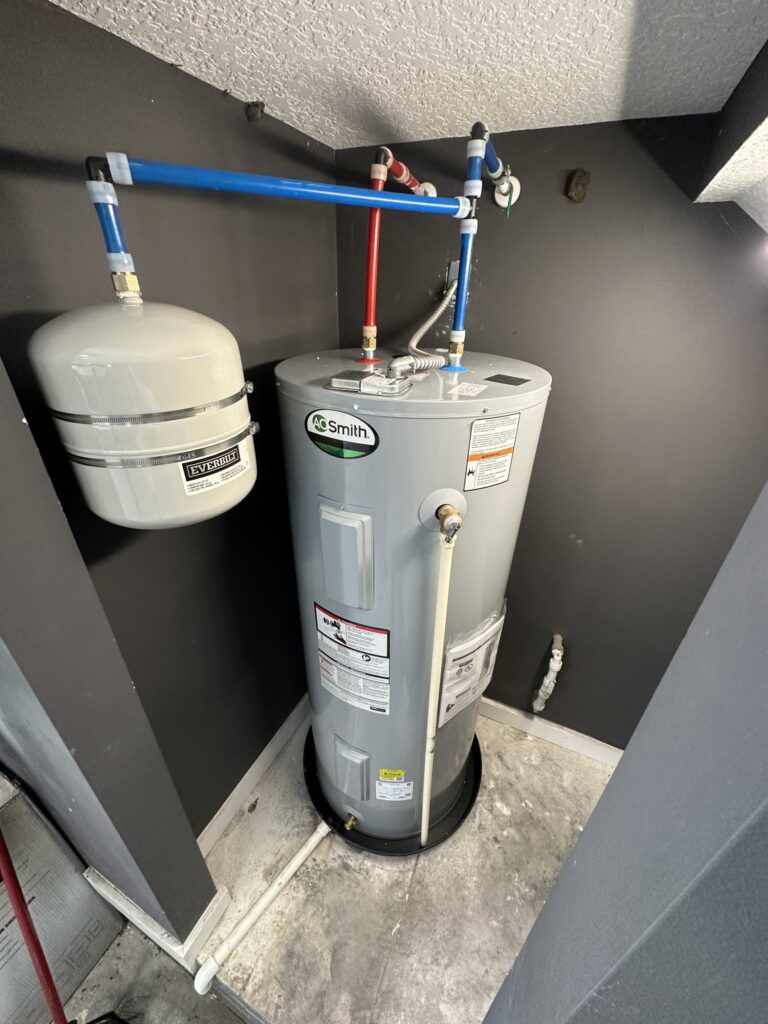
- No pan under a tank in an interior closet, laundry room, or attic. A garage tank without a pan is noted but rarely fatal on its own.
- T&P discharge line missing, corroded, capped, or ending well above the floor.
- Visible corrosion at the supply connections or the base, especially on barrier-island homes in the Hammock and Flagler Beach where salt air ages the fittings.
- No thermal expansion tank on a home with a pressure-reducing valve or backflow preventer.
- A water heater replaced without a permit, which shows up when the inspector’s date does not match any permit record.
None of those is hard to fix on a tank with life left. Together on a fifteen-year tank, they are a replacement.
The questions I get from renewal-letter calls
What does a four-point check on a water heater? Age from the rating plate, tank type, corrosion or leaks at the base and connections, the T&P discharge, and whether there is a pan. Most inspectors also note the expansion tank.
Will insurance cover a house with a fifteen-year-old water heater in Florida? Increasingly, no. Fifteen is the common line, twelve for some carriers. Below that, the surrounding install decides it.
Do I need a permit for insurance to accept the new water heater? You need a permit because the city requires one. The insurer benefits because the permit final is the proof the work was done to code, and several underwriters ask for it.
What fails a four-point? On the plumbing side: water heater age, active leaks, polybutylene supply piping, and corroded or non-functional shut-off valves. The valve question comes up often enough that our plumbing repair service in Palm Coast handles a lot of pre-renewal valve swaps.
Their renewal was one of four calls in the full guide built from one week of Palm Coast water heater calls. Once the new tank was in, the visit that keeps it out of the next letter is the one I describe in the post on water heater maintenance in Florida before hurricane season.
What the couple said afterward, and what I would tell you
They said the letter had felt like an accusation. It was a photograph of a tank that had been quietly missing three things for fifteen years. The finding was not wrong. It was just the first time anyone had looked. If your tank is past twelve and you have not had a renewal letter yet, walk out and take the four photos yourself: the plate, the base, the T&P line, the connections. If you would not want an underwriter to see them, the fix on your schedule is cheaper than the fix on theirs.
That is the whole lesson of a four-point inspection water heater finding: it fails working tanks on purpose, because working is not the standard. If you have a letter in hand or a tank that would draw one, our water heater installation and repair service in Palm Coast runs the permit, the install, and the photo set the underwriter asks for, and the $96 service call applies to the job.
Sources
- Citizens Property Insurance Corporation: Four-Point Inspection form
- Florida Office of Insurance Regulation: consumer resources
- Florida Senate: SB 2-A (2022 Special Session A)
- Florida Senate: SB 7052 (2023)
- Florida Building Code, Plumbing (8th Edition, 2023), Florida Building Commission
- City of Palm Coast Building Division: permits