

Water Heater Guide for Florida Homeowners: What Did Four Palm Coast Calls in One Week Teach Us?
- Four calls in one week cover almost every water heater decision a Florida homeowner faces: is mine dying, what should replace it, what will the insurer accept, and what does it cost.
- Palm Coast water is hard and the garages are hot. That shortens tank life to eight or ten years unless the tank is maintained, and it makes heat pump units unusually effective here.
- The code and insurance details that decide most jobs: pan and drain line, expansion tank, T&P discharge, a permit, and a raised platform on the barrier island.
- Every section links to a deeper post on that exact decision, written from the same jobs.
The situations described here are composites drawn from the types of jobs and decisions we encounter regularly. Names and specific figures are illustrative.
The second week of September brought four water heater calls to four different parts of Palm Coast, and between them they touched nearly every question I get asked about hot water in this county. A rusty drain pan in Seminole Woods. A Citizens renewal letter in the Hammock. A family on Island Estates asking about a hybrid. A six-year-old tank off Palm Harbor that would not stop tripping its breaker. If I were writing a water heater guide for Florida homeowners from scratch, I would not start with a list of types. I would start with that week, because the decisions came in the order homeowners actually face them.
So that is how this guide is built. Four houses, in order. The types, the lifespan, the codes, the insurance, and the pricing all come up because the jobs made them come up. Each section points to a longer post on that specific decision, written from the same calls.
Monday: the rusty pan in Seminole Woods, or how to tell if yours is dying
The first call was not a leak yet. The homeowner had noticed rust flakes in the drain pan under a 2011 electric tank in the garage and wanted to know whether that meant anything. It meant the glass lining inside the tank had started to fail and the steel was corroding, and it meant we were early, which is the best place to be.

Here is what I check on every tank, in order, and what each thing tells you. The rating plate first: the serial number holds the manufacture date, and Rheem, A.O. Smith[2] and Bradford White[3] each publish a date-code guide. Hers was thirteen years. Then the pan and the bottom seam with a flashlight: rust flakes or a stained seam mean the lining is gone. Then the anode rod, the magnesium rod threaded into the top that corrodes so the tank does not; on Palm Coast city water it is usually consumed by year five if nobody has replaced it, and hers was bare wire. Then the T&P valve for weeping, the connections on top for corrosion, and the drain valve for a slow flush that means sediment.
Thirteen years, rust in the pan, bare anode. That tank was in its last year. We scheduled a replacement for the following week on her calendar rather than a Saturday’s. The two symptoms she had not noticed, hot water running out sooner and a popping sound during heating, are covered in the post on how long water heaters last in Florida, which follows two identical tanks on one Flagler Beach street that died six years apart. And if her pan had held water instead of flakes, the morning would have gone the way I describe in the post on a water heater leaking from the bottom on a Saturday in Palm Coast: breaker off, cold valve closed, same-day swap.
Why tanks in Palm Coast die earlier than the box says
Two things about this place shorten a water heater’s life, and both were true in Seminole Woods. The water is hard. The City of Palm Coast Annual Water Quality Report[4] publishes the hardness, and by the USGS classification[5] it sits in the hard to very hard range, about eleven grains per gallon when I test at a hose bib. UF/IFAS Extension[6]‘s home water quality series explains the chemistry: calcium and magnesium carbonate that drop out when water is heated, landing on the bottom of the tank as sediment. Sediment makes the lower element run hotter, cracks the lining, and consumes the anode faster because mineral-heavy water conducts better.
The garage is hot. Most tanks here sit in an unconditioned garage that runs in the mid-nineties every afternoon from May through September, and heat accelerates everything chemical inside the tank. On the barrier island, in the Hammock and Flagler Beach, salt air adds exterior corrosion at the fittings and the T&P valve; NOAA and Florida Sea Grant[7] publish material on salt-aerosol corrosion near the coast, and the practical version is that a tank within a mile of the ocean shows rust on top before a tank in Bunnell does.
The result is that the ten-to-twelve-year figure on the box is a ceiling here, not a prediction. Unmaintained, eight to ten. Flushed yearly with an anode replaced around year five, twelve to fifteen. That maintenance is one hour a year, and I walk through exactly what it involves in the post on water heater maintenance in Florida before hurricane season.
Tuesday: the breaker in Palm Harbor, or repair versus replace
The second call was a six-year-old tank tripping its 30-amp breaker every day. Six is young, and a tripping breaker is almost always a part: a shorted element, a stuck thermostat, or a loose connection in the junction box. NFPA 70[8] Article 422 covers the circuit, and I meter the elements and check the connections on every one of these. His was a loose hot conductor arcing under load. Ten minutes.
But the pan had rust flakes, the anode was consumed, and the dip tube was cracked. Six years old and already corroding from the inside, which on this water is early but not rare. Here is the rule I use. Under seven years, repair almost always wins. Over ten, replacement almost always wins. Between them, the anode and the pan decide. His tank was under seven with a bad anode and rust in the pan, which would normally push me toward a repair and a new anode. Then I read the rating plate again: nine-year tank warranty, three years left. A warranty covers a leaking tank from a lining failure, so replacing it under warranty now beat repairing it and hoping the leak waited. That is the whole story of the post on whether to repair or replace a water heater that keeps tripping its breaker, and the warranty line is the part most people miss.
The types, since by Wednesday the question came up
Palm Coast is all-electric almost everywhere; natural gas service does not reach most of the city, so gas tanks and gas tankless units are propane conversions here, and few people want the yard tank and delivery contract. That leaves three real options, and the third call of the week, a family on Island Estates, was about choosing between them.
A standard electric tank uses two resistance elements. It is the cheapest to buy, the simplest to install, tolerates hard water better than anything else, and costs the most to run. The U.S. Department of Energy’s 2024 final rule[9] on residential water heater standards, effective in 2029, is written to push most larger electric tanks off this technology, which tells you where the market is going.
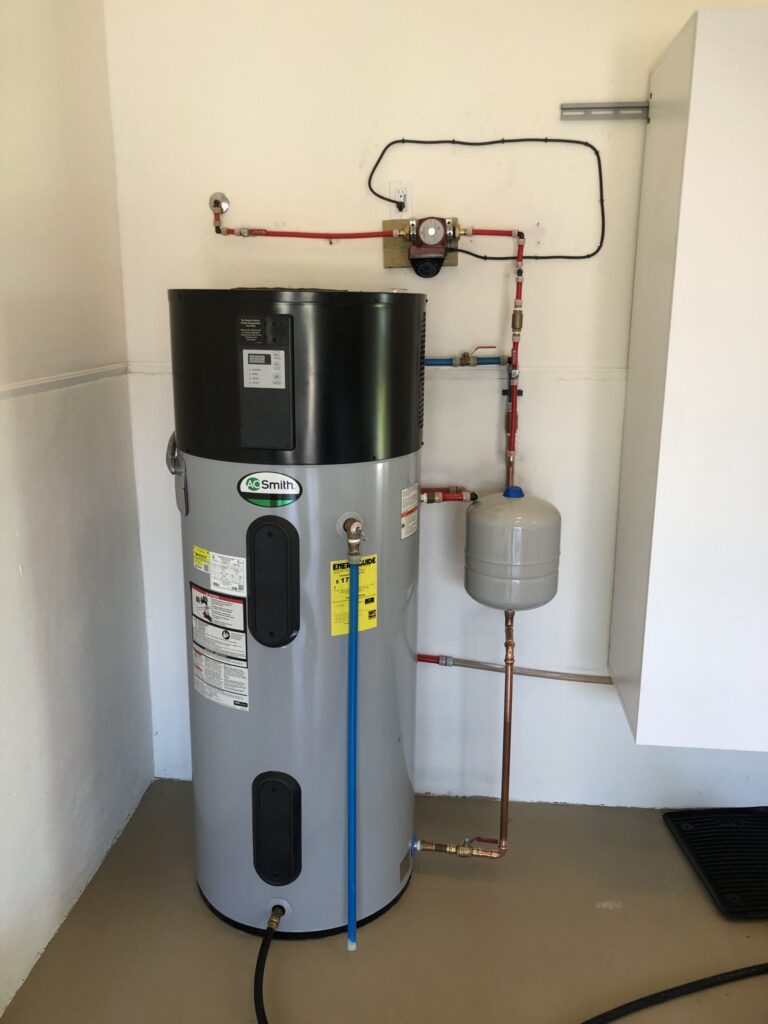
A heat pump, or hybrid, water heater runs a small compressor that pulls heat out of the surrounding air and moves it into the water, with resistance elements as backup. It needs about 700 cubic feet of air, a condensate drain, and a warm space. A Palm Coast garage is nearly the ideal environment for one; the ENERGY STAR criteria[10] and the manufacturer’s install manuals both describe conditions this county has for free. The Island Estates family put a Rheem ProTerra in a two-car garage, complained about the compressor hum for a week until we moved it off the shared wall, noticed the garage got drier, and then shared two FPL bills that showed the water-heating share of their electric use down by roughly two-thirds. The federal 25C credit that covered part of these units expired for installs after 2025, per IRS Form 5695[11], so the payback now rests on the FPL bill alone, and for them it was about three years. The full install and the bills are in the post on whether a heat pump water heater is worth it in Florida.
An electric tankless unit heats water on demand with no tank. The endless hot water is real. The catch in Palm Coast is electrical: a whole-house unit draws 112 to 150 amps at 240 volts, and most homes here have a 150-amp service that cannot spare it, so the quote includes an electrician and a panel upgrade. The second catch is the water: a small heat exchanger scales fast at eleven grains, and manufacturers require a softener or a yearly descale to hold the warranty. I priced all three for a couple in Grand Haven who came home from a rental wanting tankless, and they chose the hybrid once the panel line appeared. That kitchen-counter comparison is the post on tankless versus tank water heaters in an all-electric Palm Coast home.
The install details the code and the inspector care about
Every replacement I do in Palm Coast, whatever the type, includes the same handful of items, and they are the items that separate a permitted install from a big-box swap. The Florida Building Code, Plumbing edition[12], and the manufacturer’s manual are the references for each.
- A drain pan with a drain line that terminates somewhere you will notice it, to the exterior or an indirect drain. An interior closet or attic tank without one is a floor waiting to be replaced.
- A thermal expansion tank on any closed system, which means any house with a pressure-reducing valve or backflow preventer at the main, and most Palm Coast homes have one. IAPMO’s guidance[13] on thermal expansion explains why: heated water has to go somewhere, and without the tank it goes through the relief valve.
- A T&P discharge line run to within six inches of the floor, unthreaded at the end, no reduction, no cap. The Consumer Product Safety Commission[14] treats the T&P as the primary safety device on the tank.
- A dedicated 30-amp, 240-volt circuit on 10-gauge wire for a standard or hybrid electric, per NFPA 70 Article 422, with tight connections in the junction box.
- A plumbing permit from the City of Palm Coast Building Division[15] or the Flagler County Building Department[16], with a final inspection. It is a fixed line on every quote, and it is the line most often missing from a cheaper bid.
- On the barrier island, a raised platform. FEMA’s flood[17] maps put the Hammock and Flagler Beach in zones where a tank on the garage slab is the first appliance to take on water, and eighteen inches of pressure-treated platform is the least expensive storm-prep item on the list.
Thursday: the renewal letter in the Hammock, or what the insurer wants
The fourth call was a couple with a letter from their carrier: a four-point inspection had flagged a 2009 water heater, and the renewal would not bind until it was addressed, thirty days out. The tank was working fine. It failed anyway, and the reason it failed is the most useful thing in this guide for anyone whose tank is past twelve.
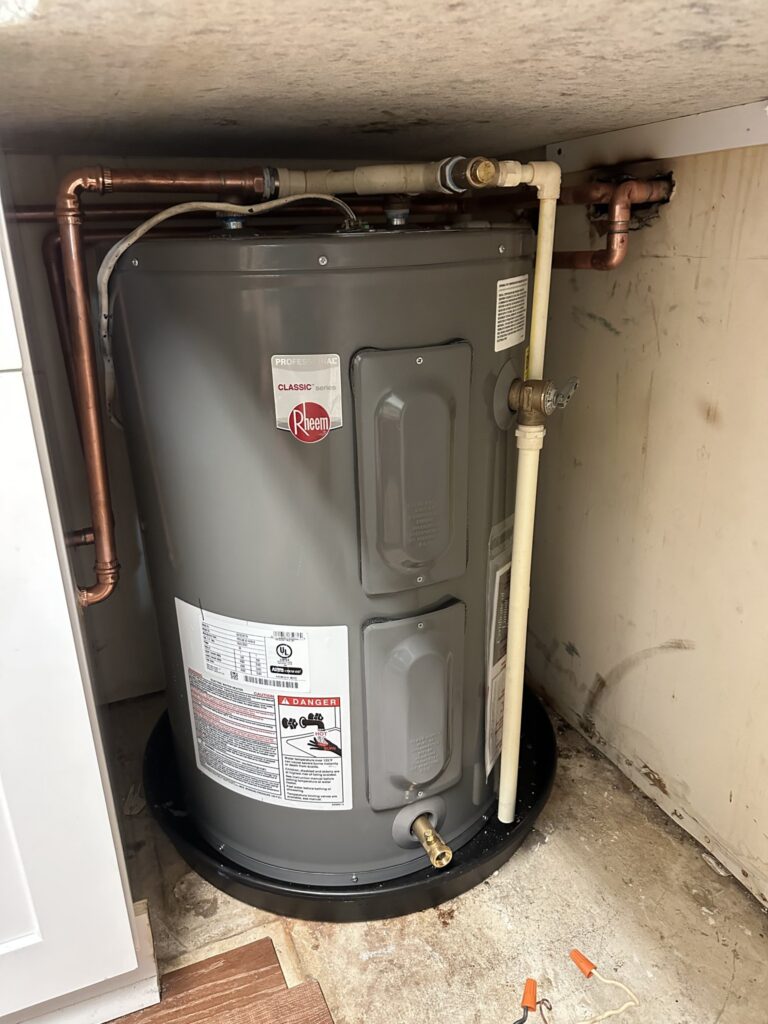
A four-point inspection is an underwriter’s risk snapshot, not a code inspection. The Citizens Property Insurance four-point form[18], in its 2023 revision, asks for the water heater’s age, type, corrosion, leaks, and pan, with photos, and the Florida Office of Insurance Regulation[19]‘s consumer guidance explains that carriers use it to decide whether to take the risk at all. Since the reforms in SB 2-A[20] and SB 7052[21], most carriers I see in Flagler County use fifteen years as a hard line for a tank and a few use twelve. Below that, the surrounding install decides it: no pan, a corroded or capped T&P line, no expansion tank, corrosion at the connections, or a replacement with no permit on record.
Their tank was fifteen with no pan, no expansion tank, and a green-crusted T&P valve that had been doing the expansion tank’s job for a decade and a half. We ran the permit on day two, installed on day four, had the city final on day six, and sent the underwriter the invoice, the permit record, and photos of the plate, pan, T&P line, and connections on day eight. The renewal bound on day eleven without a second paid inspection, which does not always happen. That timeline, and what Flagler inspectors flag most, is the post on why a four-point inspection fails a working water heater in Flagler County. If your tank is past twelve, take those four photos yourself before someone else does.
Friday: what the four quotes looked like
By the end of the week I had sent four itemized quotes by text, and they are the best answer I have to what a replacement costs here, because the total hides more than it shows. The unit is usually 40 to 60 percent of the job. The rest is the pan and drain line, the expansion tank, the connectors and T&P line, labor, the permit, and haul-away. Illustratively, that week: a like-for-like 40-gallon in a closet at about $1,600; a 50-gallon nine-year-warranty tank on a raised platform in the Hammock at about $2,150; a 50-gallon hybrid in a garage with a condensate line and isolation pad at about $3,100 against $1,700 for the standard tank in the same spot; and a warranty replacement where the homeowner paid only labor, pan, expansion tank, and permit. Prices move with the unit and the house, and I break each of those quotes down line by line in the post on what water heater replacement costs in Palm Coast when the quote is itemized.
The lines a cheaper bid leaves off are nearly always the same three: the expansion tank, the pan drain, and the permit. Those are also the three the four-point inspector photographs. I would rather explain the lines than compete on a number that does not include them, and our service call is $96 applied to the work, which is why it does not appear as a line on any of them.
The questions that came up across all four houses
Which type should I get? In a Palm Coast garage with room around the tank and a household that uses a lot of hot water, a hybrid; the FPL bill pays the difference back in a few years. In a closet, or for a light user, or when the tank is leaking today, a standard electric tank. Tankless only when the panel already has the capacity and there is a softener in the house.
How long will it last? Eight to ten years unmaintained on this water. Twelve to fifteen with a yearly flush and an anode around year five.
Do I need a permit? Yes, in the city and the county, with a final inspection. The insurer will ask for the record.
What will the insurance company accept? A tank under twelve to fifteen years depending on the carrier, in a pan with a drain, with an expansion tank on a closed system, a proper T&P line, no visible corrosion, and a permit on file.
What can I do myself? The yearly flush, the T&P lever test, and checking the expansion tank charge with a tire gauge. Leave the anode to a plumber; the hex seizes and the rod is as tall as the tank. Everything else on the list, including the shut-off valves that four-point inspectors also photograph, falls under what our plumbing repair service in Palm Coast does under the service call.
Is the water itself worth treating? If the scale on the shower door bothers you as much as the sediment in the tank, a softener changes the math on every water-using appliance in the house, and that is a separate conversation on our whole-house filtration and softening page.
What that week taught me about how to answer the question
Four calls, four different answers, and none of them started with a type. They started with a rating plate, a pan, and an anode. The Seminole Woods tank got replaced on her schedule. The Palm Harbor tank got replaced under warranty. The Island Estates family got a hybrid and a lower bill. The Hammock couple kept their policy. The common thread was that each of them looked, or let me look, before the tank decided for them.
If you want the short version of a water heater guide for Florida homeowners, it is this: find your tank’s age this week, look in the pan, and if either number worries you, get the itemized quote before the letter or the puddle arrives. Our water heater installation and repair service in Palm Coast does that check on every service call, and the $96 applies to whatever comes next.
Sources
- Rheem: water heater manuals and serial-number date codes
- A. O. Smith: water heater serial-number date codes
- Bradford White: water heater serial-number date codes
- City of Palm Coast Annual Water Quality Report (Consumer Confidence Report)
- USGS Water Science School: Hardness of Water
- UF/IFAS Extension (EDIS): Home Water Quality series
- NOAA / Florida Sea Grant: coastal corrosion
- NFPA 70, National Electrical Code, Article 422
- U.S. Department of Energy, Appliance and Equipment Standards: Residential Water Heaters (2024 final rule)
- ENERGY STAR: Heat Pump Water Heaters
- IRS: About Form 5695, Residential Energy Credits
- Florida Building Code, Plumbing (8th Edition, 2023), Florida Building Commission
- IAPMO: thermal expansion guidance (Uniform Plumbing Code)
- U.S. Consumer Product Safety Commission: water heater safety
- City of Palm Coast Building Division: permits
- Flagler County Building Department: permits
- FEMA Flood Map Service Center
- Citizens Property Insurance Corporation: Four-Point Inspection form
- Florida Office of Insurance Regulation: consumer resources
- Florida Senate: SB 2-A (2022 Special Session A)
- Florida Senate: SB 7052 (2023)