

How Much Does a Water Softener Cost in Florida When It Is Installed in a Palm Coast Garage With Permit and Bypass?
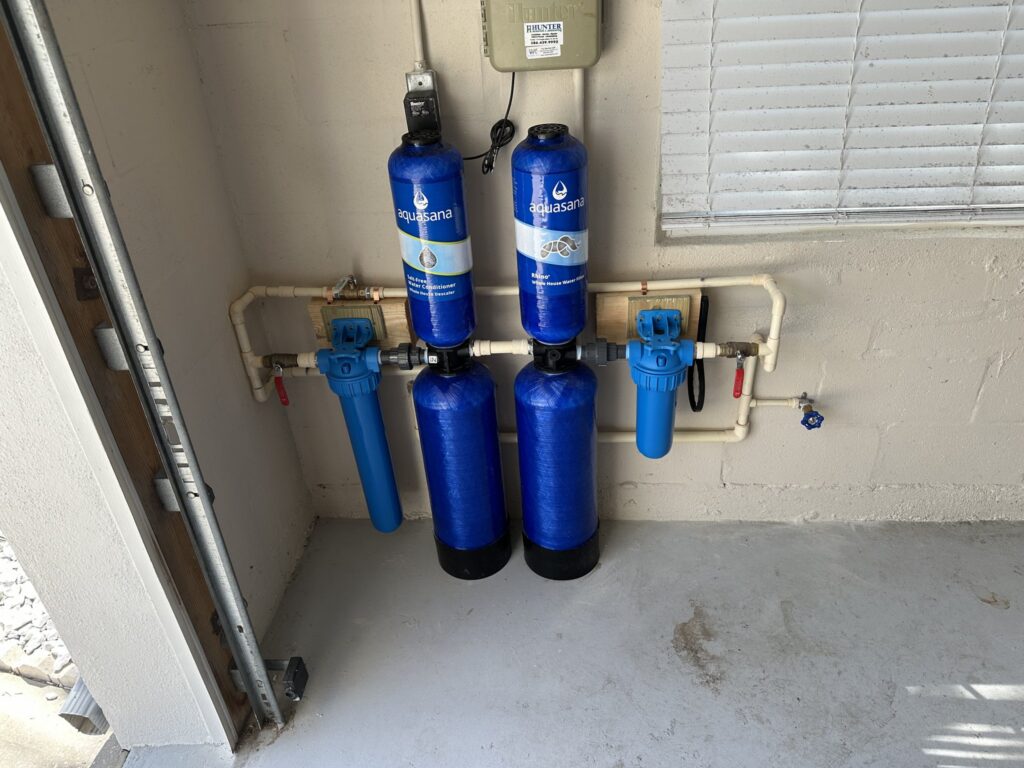
- A softener installed in Palm Coast runs in the range the service page lists. The unit is about half of that; the loop, bypass, drain, permit, and labor are the other half, and they are what the big-box price leaves out.
- Sizing is grains times people times a day of use. Eleven grains and four people is a specific tank, not the one on sale.
- Newer Palm Coast garages often have a softener loop already stubbed in. That cuts the labor line noticeably.
- Salt: one to two bags a month with the irrigation bypassed. Three or four without. The bypass is the cheapest line on the quote and the one that pays back fastest.
The situations described here are composites drawn from the types of jobs and decisions we encounter regularly. Names and specific figures are illustrative.
Two softener quotes went out the same week, one to a family of four in Seminole Woods and one to a couple in the Hammock who also wanted chloramine gone, and both homeowners asked a version of the same question: what does water softener cost in Florida actually include, because the big-box price was half of mine. So I read both quotes aloud, line by line, and this post is that reading, with the sizing math and the salt math that the sticker on the box does not show.
Line one: the unit, and how it is sized
A softener is sized in grains of capacity: how much hardness the resin can remove before it needs to regenerate. The math is hardness in grains per gallon, times gallons per person per day, times people, times the days between regenerations you want. Palm Coast water is about eleven grains per the City of Palm Coast Annual Water Quality Report[1]. A person uses roughly seventy-five gallons a day. Four people is three hundred gallons, times eleven is thirty-three hundred grains a day, and a metered softener that regenerates about once a week needs a capacity in the range of twenty-four to thirty-two thousand grains with sensible salt settings. That is a specific unit. The Hammock couple, two people, needed less, and I quoted a smaller tank. The big-box unit on sale that week was sized for a smaller house on softer water, which is why it was cheaper; it would have regenerated every other night in Seminole Woods and used salt like a snowplow.
Both units carry NSF/ANSI[2] 44 certification, which is the standard for cation-exchange softeners and the mark I look for before the price. Metered, not timed: a metered valve counts gallons and regenerates when the resin is actually spent, which cuts salt use roughly in half compared to a timer. The unit is about half of the installed price on both quotes.
Line two: the loop and the bypass
A softener needs a loop: the main comes in, goes out to the softener, and comes back, with a bypass valve so the house can run on raw water if the softener is down or being serviced. In Palm Coast houses built since the mid-2000s, builders often stubbed a softener loop into the garage wall next to the water heater, two capped pipes a foot apart, and if that loop is there the tie-in is an hour. The Seminole Woods house had one; the Hammock house, older, did not, which meant cutting into the main and building the loop from scratch. That is the largest labor difference between the two quotes and it is entirely about the house, not the softener.

The bypass has a second job: irrigation. The sprinkler system should tee off before the softener so the lawn gets raw water. Softening irrigation water is wasted salt and, on the volumes a Florida lawn uses, it can double the monthly bags. On both quotes I moved or confirmed the irrigation tee upstream. It is a small line on the quote and the one that pays back fastest.
Line three: the drain
A softener regenerates by flushing brine through the resin and sending it to a drain. That needs a drain line with an air gap to a standpipe, utility sink, or floor drain within reach. The Seminole Woods garage had a utility sink ten feet away; the Hammock garage had no drain, so the line ran through the wall to the exterior and into a dry well, which the Florida Building Code, Plumbing[3] edition allows with an air gap and which is common here. That was the second labor difference. On a septic house, which neither of these was, the drain routing and the metered regeneration matter for the drainfield, which the post on water softener versus salt-free conditioner covers.
Line four: the permit
A softener install that ties into the main and adds a drain is permitted plumbing work under the City of Palm Coast Building Division[4], and I pull the permit under my license and bill it at cost. It is a small fee and one inspection. The big-box price does not include it because the big-box installer usually does not pull one. It is on my quote because the inspector sees the backflow protection on the drain and the tie-in on the main, and because when the house sells the buyer’s inspector will ask.
Line five: the carbon tank, on the Hammock quote only
The Hammock couple wanted the chloramine smell gone as well as the scale, which is two tanks: catalytic carbon ahead of the softener. The carbon tank adds its own line, in the range the service page lists for a whole-house filter, and it shares the loop, the bypass, the pre-filter, the permit, and the labor day with the softener, which is why the two-tank quote was less than two separate installs would be. The reasoning for two tanks and the order they go in is the post on whole house water filter versus water softener; the specific carbon unit I install most is the post on an Aquasana Rhino review from the plumber who installed one.
Line six: labor and the pre-filter
A sediment pre-filter ahead of everything, in a clear housing, which is on every install I do. Unions on the tanks. Mounting board. Half a day for the Seminole Woods loop-ready garage, most of a day for the Hammock build-from-scratch with two tanks and the exterior drain. The $96 service call for the water test and walkthrough, applied to the work.
What the big-box price leaves out
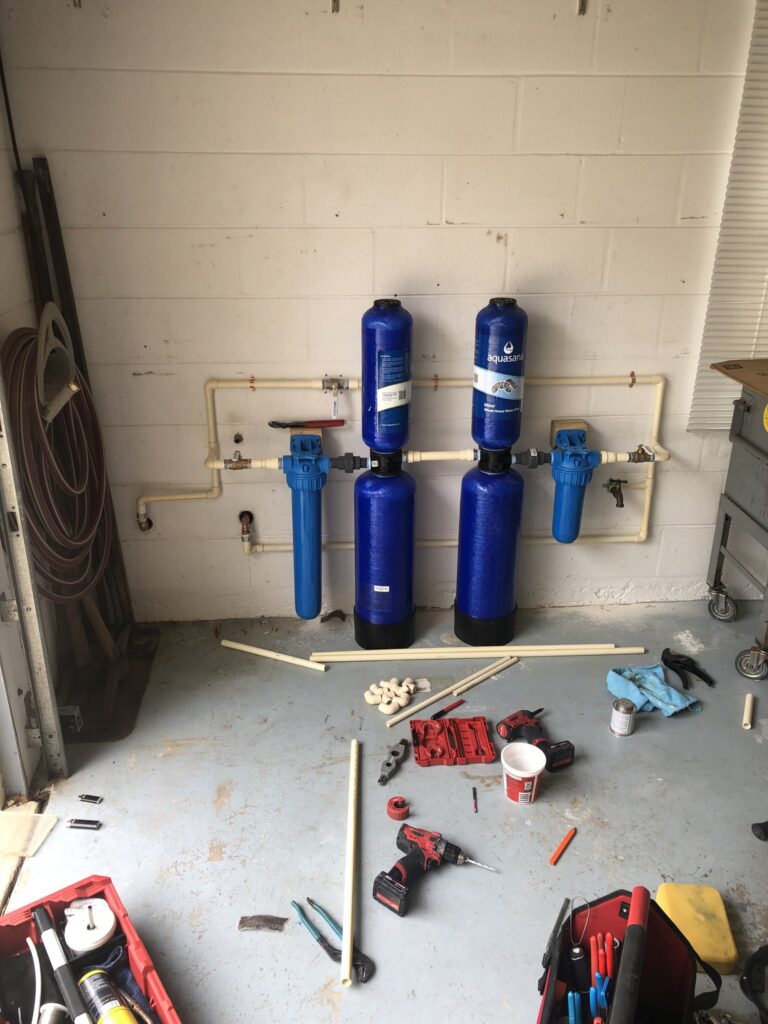
The unit on the shelf is a unit. It does not include the loop if there is none, the bypass, the drain line and air gap, the pre-filter, the irrigation tee, the permit, or a plumber who sized it to the water. The installers big-box stores contract typically quote a flat install that assumes a loop exists and a drain is adjacent, and add change orders when they are not. When a homeowner shows me a big-box number that is half of mine, the difference is almost always those lines, and the way to compare is to ask what happens if there is no loop and no drain. The Water Quality Association[5]‘s consumer guidance has a checklist for buying a softener, and most of it is about the install, not the tank.
The salt math
Seminole Woods, four people, eleven grains, metered, irrigation bypassed: about a bag and a half of salt a month, forty-pound bags. Without the irrigation bypass it would have been three or four. Hammock, two people, carbon ahead of the softener: under a bag a month. Salt is a few dollars a bag at the big box and more delivered; over a year it is the ongoing cost of a softener and it is modest with a metered valve and the sprinklers bypassed. A timer-based unit regenerating on a fixed schedule doubles it. That is the most common thing I fix on softeners other people installed.
What people ask holding two quotes
How much does a water softener cost installed? The unit is about half; the loop, bypass, drain, pre-filter, permit, and labor are the rest. The service page has the range.
Why is the big-box price lower? It is the unit, or the unit plus an install that assumes a loop and a drain exist.
What size softener do I need? Grains of hardness times gallons per day times people, sized to regenerate about weekly. Eleven grains and four people is a specific tank.
Do I need a permit? Yes, for the main tie-in and the drain. It is billed at cost.
How much salt will it use? One to two bags a month with the irrigation bypassed and a metered valve. More without either.
Both quotes went to households that appear in the whole house water filtration system guide that starts with a glass of Palm Coast tap water. What the pre-filter on either install will look like across a year, and when to change it, is the post on how often to change a whole house water filter. And the well version of this quote, which has more tanks and a lab report on it, is the post on the well water treatment system that worked after two failed.
What both garages have now
Seminole Woods: one tank on the builder’s loop, a brine bin, a pre-filter, a bypass, and a bag and a half a month. The Hammock: two tanks on a new loop, a drain through the wall, and under a bag. Both homeowners took the itemized quote over the big-box number once they saw what the lines were, which is the point of reading it aloud.
If you are pricing water softener cost in Florida and the numbers do not match, ask each one what happens when there is no loop and no drain. Our whole house water filtration service in Palm Coast itemizes every line, sizes the tank to the water and the house, and applies the $96 service call to the install.
Sources
- City of Palm Coast Annual Water Quality Report (Consumer Confidence Report)
- NSF/ANSI 42, 44, 53 and 58 drinking water treatment standards
- Florida Building Code, Plumbing (8th Edition, 2023), Florida Building Commission
- City of Palm Coast Building Division: permits
- Water Quality Association: consumer guidance