

Is Drano Bad for Pipes, and What Did a Bottle a Month Do to a 1980s Cast-Iron Drain in Palm Coast?
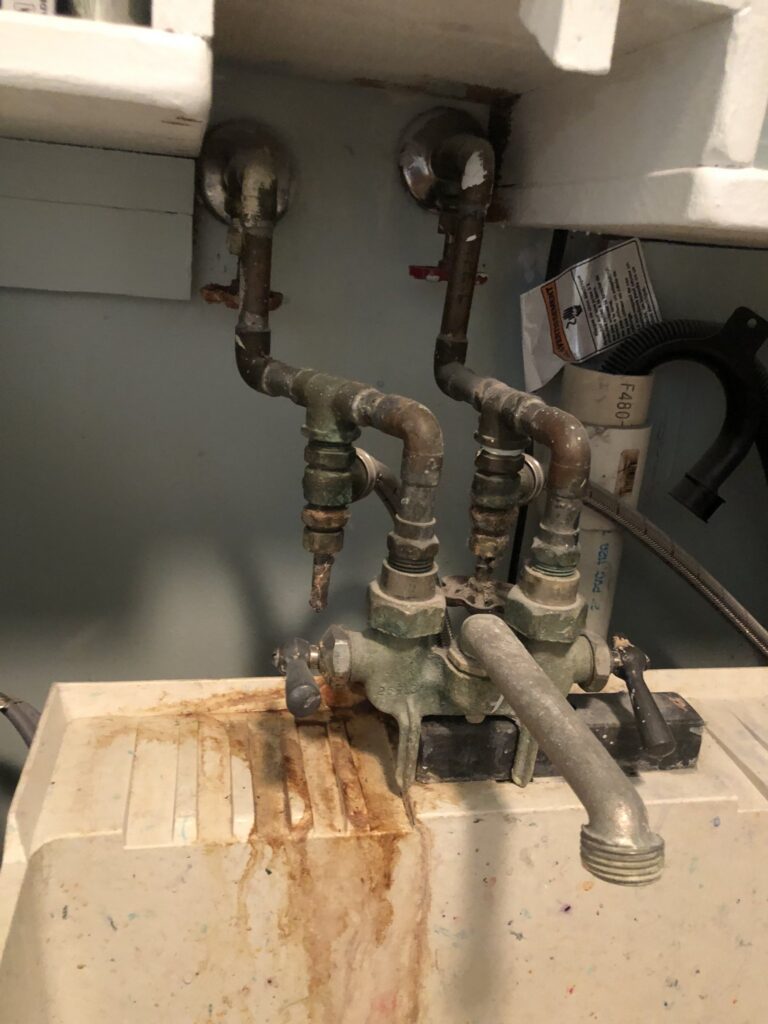
- Caustic drain cleaner generates heat and dissolves organic matter. In a partly blocked pipe it sits, stays hot, and works on the pipe as long as it works on the clog.
- On the 1980s cast iron under a lot of Palm Coast homes, that means the trap arm and the branch thin from the inside until they weep. This one leaked inside a wall for weeks before anyone knew.
- Standing drain cleaner is a burn hazard for the next person who opens the trap, and that person is usually a plumber.
- The alternative is boring: a strainer, hot water, an enzyme product for maintenance, and a cable or jet when it actually clogs.
The situations described here are composites drawn from the types of jobs and decisions we encounter regularly. Names and specific figures are illustrative.
The landlord had four rentals in Palm Coast’s F-section, all built within a few years of 1985, and a system. When a tenant reported a slow bathroom sink, he dropped off a bottle of drain cleaner. When it slowed again the next month, another bottle. He had done this for about two years on one particular sink before the tenant called him about a stain spreading on the wall below the vanity. He called me and asked, more or less, Is Drano bad for pipes or is this something else. It was the cleaner. I could show him, because I had to cut the pipe out anyway.
This post is that cut-open pipe, what the product actually does chemically, why 1980s cast iron is the worst possible place for it, and the short list of things I use instead. It is not a lecture. He was doing what the bottle said to do.
What was inside the wall
Behind the vanity, the sink’s trap arm ran about 18 inches through the wall to a cast-iron sanitary tee on the stack. The trap arm itself was galvanized steel, which is what a lot of this era’s builders used for the short run between a PVC trap and a cast stack. When I opened the drywall, the bottom of that galvanized arm had a seam of orange scale along its length and a pinhole at the low point, weeping every time the sink drained. The cast tee below it had a rough, pitted ring at the waterline. The wall cavity had been wet for weeks.

I cut the arm out and split it lengthwise on the tailgate. The top half of the pipe wall was close to full thickness. The bottom half, where liquid sits when a slow drain holds it, was about a third as thick, with the texture of a rusted can. That is what two years of monthly caustic cleaner, sitting in a pipe that was never fully draining, had done.
What the product is, and why it worked on the pipe
The most common liquid drain cleaners are sodium hydroxide based, with some formulas adding sodium hypochlorite or aluminum to boost the reaction. The manufacturer safety data sheets[1] for these products describe the mechanism: the caustic reacts with fats and proteins, saponifies grease, and generates heat as it does so. In a pipe that flows, that reaction happens, the result washes down, and the exposure to the pipe is brief. In a pipe that is partly blocked, which is the only reason anyone pours it, the product sits at the blockage, stays hot, and stays in contact with whatever the pipe is made of until the blockage yields or the product exhausts.
PVC tolerates that reasonably well, though repeated heat cycles are not good for solvent-welded joints. Galvanized steel and cast iron do not. The Cast Iron Soil Pipe Institute[2]‘s service-life guidance is candid about the two things that shorten cast iron’s life: aggressive chemistry in the waste stream and long-term contact with corrosive liquids at the pipe’s invert, the bottom of the pipe where water sits. Monthly caustic in a slow drain is both of those at once, aimed at the one part of the pipe that already has the least wall left. The scale I found on the bottom of that arm was the pipe converting itself into rust one bottle at a time.
The thing nobody thinks about: the next person to open the trap
The tenant had poured a bottle two days before I arrived. When I pulled the trap under the sink, the standing water in it was still caustic enough to feel slippery through my glove, and a drop that landed on my forearm left a mark I had for a week. This is the part of the drain cleaner conversation that matters most to me professionally: a plumber’s cable turning through standing caustic sprays it. A plumber opening a trap pours it into a bucket and onto his hands. I ask every customer whether anything has been poured before I open a line, and I have declined to cable a line the same day when the answer was yes.
If you have already poured it and it did not work, tell whoever comes next. It changes how they work and what they wear.
The septic version of this call, out in Bunnell
The same landlord has a fifth property west of Bunnell on a septic tank, and he asked whether the bottles had been going into the tank there too. They had. A septic system is a bacterial process; the tank digests what the bacteria can eat, and the drainfield disposes of the liquid. UF/IFAS Extension[3]‘s home water quality series and the Florida Department of Health[4]‘s guidance on onsite systems both flag caustic and chlorine products as things that kill the bacterial population when dosed regularly. One bottle in a 1,000-gallon tank is diluted. A bottle a month for two years is a tank that has been running on a fraction of its biology, which shows up as sludge building faster and the drainfield getting more solids than it should. That tank got pumped and inspected the following week, on my recommendation, and the pumper reported exactly what I expected.
What I use instead, in order
Here is the honest list, and it is short. For a sink that is slow, a strainer in the drain and a monthly pour of near-boiling water down a bathroom sink, not a toilet or a PVC kitchen line, does more than any chemical. For a sink that is blocked, a hand-crank cable through the trap arm, which is a ten-minute job on most vanities. For maintenance on a line that has been cleared, an enzyme or bacterial drain product, which digests organic film slowly rather than dissolving it fast; these are the products I actually leave under a sink after a job, and I explain the habits around them in the post on how a Palm Coast customer went three years without a drain callback.
For a line that keeps coming back, a camera, because a recurring slow drain has a reason, and the reason is almost never something a bottle fixes. On this landlord’s sink the reason was a galvanized arm that had been narrowing with scale for decades and would have needed replacement eventually. The cleaner just moved eventually to now and put it inside a wall.
What the repair involved, and what it would have been
We replaced the galvanized arm with PVC, replaced the cast tee with a no-hub coupling and PVC tee, cabled the branch to the main, and cameraed it to confirm the stack below was sound. Then the drywall, which was the landlord’s own crew. The plumbing was about two hours. Had the sink been cabled the first time it slowed, two years earlier, it would have been a ten-minute trap arm cleaning under the $96 service call, and the arm would have lasted a while longer. The two-inch difference between a slow drain and a wall repair was twenty-four bottles.
I mention the camera because a kitchen line in the same house had been slow too, and it turned out to have a grease sleeve that a cable would only tunnel through; that is the story in the post on why a Palm Coast kitchen line needed jetting after two snakings. He asked for a scope on all four rentals afterward, which is the post on what a sewer camera inspection costs in Palm Coast and when it is worth it. On rentals, it is.
What people ask when I show them the pipe
Does it damage PVC or cast iron? PVC tolerates occasional use. Cast iron and galvanized steel corrode from repeated use, especially where the liquid sits at a slow drain.
Why do plumbers say not to use it? Two reasons: it works on the pipe as much as the clog when the drain is slow, and it makes the line dangerous to open for whoever comes next.
Is it safe for septic? Occasionally, diluted, yes. Regularly, no, because it kills the tank’s bacteria.
What if it does not work? Stop pouring. Tell the plumber it is in there. The clog is a cable or camera job at that point.
What can I use instead? Strainer, hot water, a hand cable, and an enzyme product for maintenance. And a roof check if the drain gurgles, which is the other story in the post on tree roots in a Palm Coast sewer line only in the sense that the cause is usually not in the sink.
The three houses in the full guide to clogged drains in Palm Coast homes, built from three houses on one street include a shower drain where a bottle of the same product had turned a hair mat into glue. It is the same chemistry at a smaller scale.
What the landlord does now
Every slow drain in his four rentals gets a hand cable on the first report, and the tenants have a strainer and an enzyme bottle under each sink with a note on it. He keeps the split trap arm in his truck, he told me, for the next time a tenant asks why there is no drain cleaner in the cabinet. It is a better explanation than anything I could write.
So, Is Drano bad for pipes? For the pipes under a 1980s Palm Coast house, over time, yes, and for the person who opens the trap afterward, immediately. Our drain cleaning service in Palm Coast clears a slow drain with a cable under the $96 service call, which is less than two years of bottles and does not end inside a wall.