

Should I Replace the Faucet Cartridge or the Whole Faucet When It Drips Again Six Months Later in Palm Coast?
- A cartridge that fails in six months on a faucet that ran twenty years is not a bad cartridge. It is a valve body that has been scored by hard-water grit.
- Palm Coast city water runs about eleven grains hard. Cartridges here last a third as long as the brochure says.
- Rule I use: first cartridge, replace it. Second cartridge inside two years, look at the body. Scored body, new faucet.
- The lifetime warranty is real on the good brands, and they ship the part. It does not ship a plumber, and it does not fix a scored body.
The situations described here are composites drawn from the types of jobs and decisions we encounter regularly. Names and specific figures are illustrative.
The faucet had dripped once, six months earlier, and a cartridge had fixed it. Now it was dripping again, the same slow tick into the kitchen sink at night, and the homeowner had done the research and found that the manufacturer would send another cartridge for free. Her question was the right one: should she replace the faucet cartridge or the whole faucet, given that the last cartridge had lasted six months on a faucet that had gone twenty years on the first one? I told her the answer was inside the valve body, and I would know in five minutes.
This post is that five minutes, what the body looked like, why the second cartridge would have failed too, and the faucet she ended up with. I have been using this job as my example for the cartridge question since, because it is the cleanest version of it I have seen.
How a cartridge faucet works, in one paragraph
A single-handle kitchen or bath faucet has a cartridge, a cylinder of plastic or brass with rubber seals and a stem, sitting in a machined brass valve body. Moving the handle rotates or lifts the cartridge, aligning ports to mix hot and cold. The seal between the cartridge and the body is what stops water when the handle is off. When a faucet drips from the spout, that seal has failed: the cartridge’s rubber has worn, or the body’s surface the rubber presses against is no longer smooth. A new cartridge fixes the first. Nothing but a new body fixes the second, and on most faucets the body is the faucet.
What twenty years of Palm Coast water does to brass
Palm Coast city water is drawn from wells and treated, and the City of Palm Coast Annual Water Quality Report[1] lists its hardness around eleven grains per gallon, which the USGS classification[2] puts at the hard end of the scale. Hardness is dissolved calcium and magnesium. As water passes through a faucet, some of it plates out as scale on every surface it touches, and some of the scale that forms upstream in the water heater and supply lines breaks loose and travels as grit. Grit through a cartridge faucet is sandpaper on the seal surfaces. On soft water a cartridge seal can last fifteen years. On this water I see them go in five to seven on a new faucet, and much faster once the body is scored.
Moen[3]‘s and Delta[4]‘s service bulletins both acknowledge this in their own language, with cleaning and descaling steps for hard-water areas and a warranty that covers the cartridge but not the effects of water conditions on the finish or the body. That is fair. They did not choose the water.
What I found in the valve body
Water off at the stops, handle off, retaining clip out, cartridge pulled. The six-month-old cartridge looked fine, which was the first clue: rubber intact, no visible wear. I put a flashlight into the body. The brass bore had two fine longitudinal scratches on the hot side, running the full depth where the cartridge seal rides, and a ring of scale at the bottom where the old cartridge had sat for twenty years. Those scratches are what happens when grit gets between a hardened seal and the body and the handle gets worked a few thousand times. A new cartridge seats against them and seals for a while because the rubber is soft. As the rubber takes a set, the scratches become channels. Six months, roughly, on this water. A second cartridge would do the same.
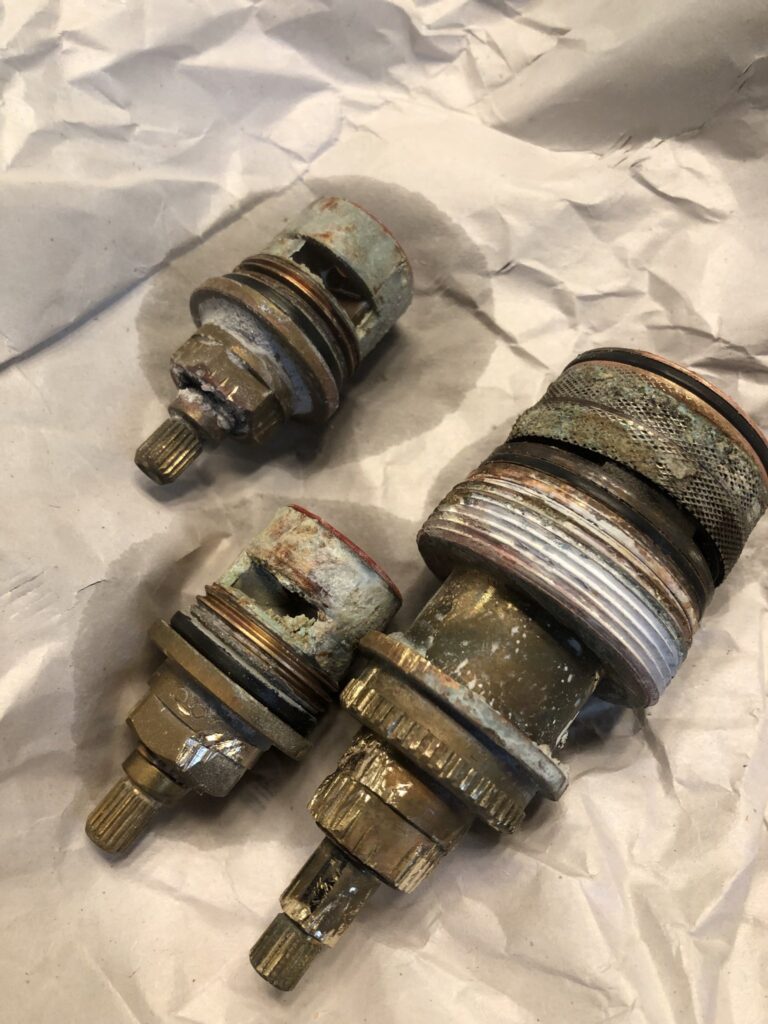
I showed her with the light. That is the part of the visit that matters, because the decision is easy once you have seen it and impossible to make from a brochure.
The rule I use, and the exception
First drip on a faucet, replace the cartridge. It is the cheap answer and it is usually right. Second drip within two years of that cartridge, pull it and look at the body. If the bore is smooth, it was a bad cartridge or a bad install and another one is fine. If the bore is scored, the faucet is done, and a third cartridge is money spent to be back here in six months. The exception is a faucet worth saving, which in practice means a high-end model where the body is a replaceable part or a fixture with a finish and a style the homeowner cannot buy again. Her faucet was a builder-grade chrome single-handle from the mid-2000s. Nothing about it was worth a third cartridge.
The faucet she chose, and why ceramic
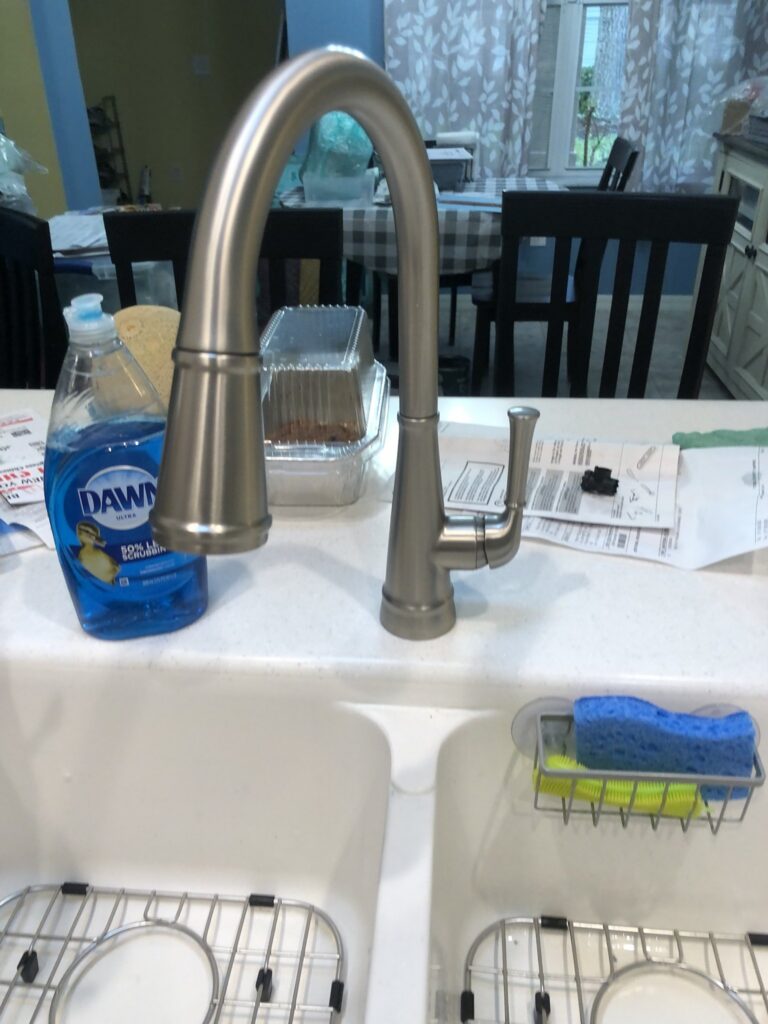
She wanted one that would not do this again, and the answer to that on hard water is a ceramic-disc valve. Instead of rubber seals sliding in a brass bore, two polished ceramic discs rotate against each other; they are harder than the grit, and they lap themselves smoother with use rather than scoring. Most mid-range faucets from the major brands now use them. I also pointed her toward a brand whose lifetime warranty actually ships parts without an argument, because the warranty is only worth what it does when you call. She chose a pull-down kitchen model in a brushed finish, and I installed it that afternoon with new supply lines, because a twenty-year-old braided line is the wrong thing to reuse on a new faucet.

One more thing I check on a kitchen faucet swap now, because the rule changed: the faucet has to meet the EPA lead-free rule[5], which is the NSF/ANSI 372 standard for wetted brass. Everything the major brands sell today does. A used or bargain-bin faucet may not, and the price difference is not worth the question.
What it cost, against the alternative
The cartridge route would have been the service call and a short labor charge for a free part, and a return visit in six months for the same. The faucet route was the service call applied to the install, the labor for the install, and the faucet, which she bought herself from the list I texted her. The total was more on the day and less by the end of the year, and it is the same math I lay out in the post on what five Palm Coast service calls actually came to, where a faucet install is one of the five tickets on the tailgate.
What people ask at the sink
How do I know if the cartridge is bad? A drip from the spout with the handle off, or a handle that is stiff or slips. Pull it and look at the seals; then look at the body.
Is a lifetime warranty worth anything? On the major brands, yes, they ship the part. They do not ship labor, and they do not cover a scored body.
How long do cartridges last? Ten to fifteen years on soft water. Five to seven here, and much less once the body is damaged.
Why does my faucet drip after replacing the cartridge? The valve body is scored or scaled, the cartridge is the wrong one for the model, or the retaining clip is not fully seated. Usually the first.
Cartridge or new faucet? First failure, cartridge. Second inside two years, look at the body and decide with a flashlight.
The same six-month-return pattern shows up under the sink in the post on the garbage disposal that hummed but would not spin, where the unjam bought a week and the replacement bought a decade, and in the post on why a toilet keeps running after a new flapper, where the mineral crust on the fill valve is the same water doing the same thing. The valves I shut to do this job are the ones that fail a four-point, in the post on what insurers look for in shut-off valves. And the dripping cartridge from Seminole Woods that week is in the guide to common household plumbing problems in Palm Coast.
What the sink sounds like at night
Nothing. The ceramic faucet has been in for a while now and the finish looks the way it did the day it went in, because the water here is hard on brass bores and not on brushed nickel. The old faucet’s body is in my shop, and I show the scratches to customers who are on their second cartridge. It has settled more arguments than any brochure.
If you are asking whether to replace the faucet cartridge or the whole faucet because the first one only lasted a season, the answer is in the bore, and it takes five minutes to look. Our plumbing repair and service in Palm Coast pulls the cartridge under the $96 service call, shows you the body, and applies the $96 to whichever fix you choose.
Sources
- City of Palm Coast Annual Water Quality Report (Consumer Confidence Report)
- USGS Water Science School: Hardness of Water
- Moen: faucet cartridge warranty and hard-water service guidance
- Delta Faucet: warranty and care guidance
- EPA: Use of Lead Free Pipes, Fittings, Fixtures, Solder and Flux (NSF/ANSI 372)