

Why Is My Water Heater Leaking From the Bottom, and Do I Have Minutes or Days?
- A puddle at the base of the tank is either a fitting, the T&P discharge, the drain valve, or the tank itself. Only the last one is fatal.
- Two shut-offs stop the damage: the breaker for an electric heater, then the cold-water valve on top of the tank.
- On a tank past ten years, a bottom leak on Palm Coast’s hard city water is almost always the liner, and the decision is speed, not repair.
- Insurers care about the age of the tank and photos of the failure. Keep both.
The situations described here are composites drawn from the types of jobs and decisions we encounter regularly. Names and specific figures are illustrative.
The text came in at 7:40 on a Saturday morning: a photo of a garage floor in Palm Coast’s C-section with a dark half-circle spreading out from under a 50-gallon electric tank. A water heater leaking from the bottom looks the same in almost every photo I get. The water is clear, it is quiet, and the homeowner is standing in it wondering whether this is a mop job or a phone call. It is usually both, and the order matters.
This post walks through that morning the way it happened, because the sequence is the useful part. What I asked over the phone, what I found when I got there, and why an eleven-year-old tank on city water ends the way this one did.
The two things I asked before I got in the truck
First: is it an electric tank? Almost every home in Palm Coast is all-electric, and this one was. That means the first shut-off is not a valve, it is a breaker. I had her go to the panel, find the double-pole 30-amp breaker labeled water heater, and flip it. An electric element running in a tank that is losing water will burn out in minutes once the water level drops below it, and a burnt element on a tank you might have saved is a bad way to start the day. The U.S. Consumer Product Safety Commission[1]‘s guidance on water heaters says the same thing in more formal language: de-energize before you touch anything.
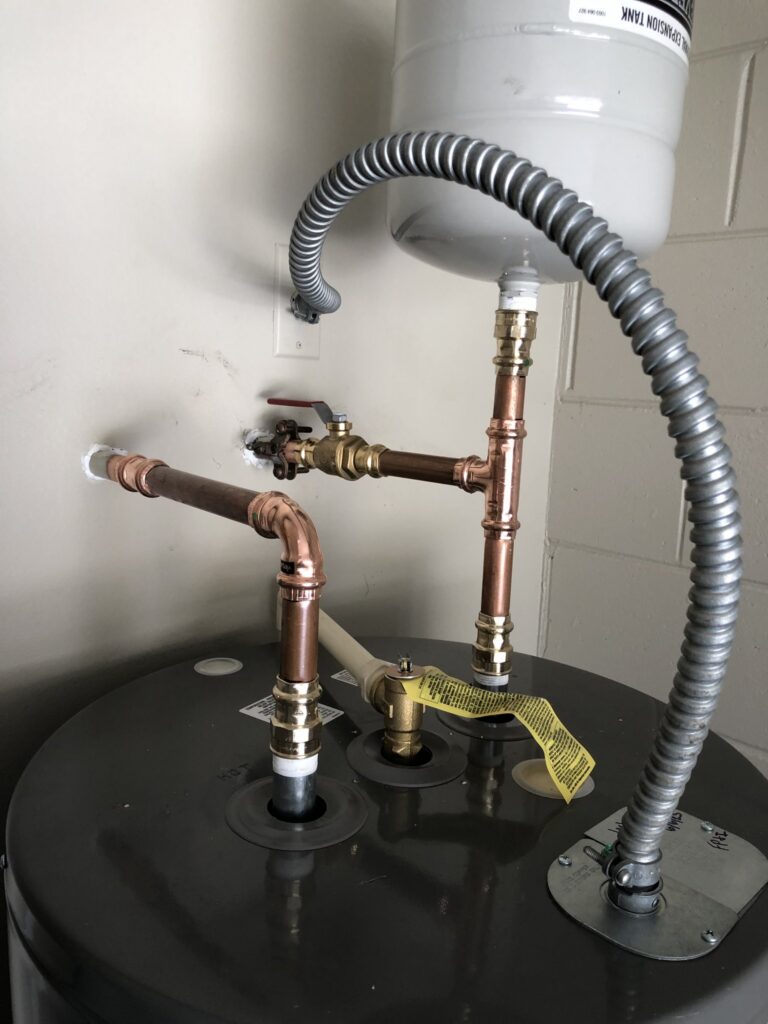
Second: find the cold-water shut-off. On this tank it was a quarter-turn ball valve on the copper line coming down into the top of the heater. On older Palm Coast installs it is often a gate valve with a round handle that has not been turned since the Bush administration. She had a ball valve. Quarter turn, water stopped feeding the tank. The puddle stopped growing. That bought us time.
If the shut-off on the tank is stuck or missing, the main valve at the house does the same job. Most homes here have one where the supply enters the house near the front hose bib, or at the meter box by the street. It is worth finding yours before you need it.
Where the water was actually coming from
A bottom leak has four suspects, and three of them are cheap. When I got there I did what I always do: dried the top of the tank and every fitting with a paper towel, then watched. Water runs down. A leak at the cold inlet, the hot outlet, or a corroded nipple on top will show up as a wet trail down the jacket before it ever reaches the floor. Those are fittings. They get replaced for parts and an hour, the kind of visit our plumbing repair service in Palm Coast handles under the $96 service call.

The temperature and pressure relief valve, the brass valve on the side with the copper pipe running down to the floor, is suspect two. If the T&P is dripping, the tank is either too hot or the house pressure is too high. In Palm Coast, high static pressure with no expansion tank is a common cause. That is a valve and an expansion tank, not a new heater. I cover the expansion-tank question in the post on what an itemized water heater quote in Palm Coast actually includes.
Suspect three is the drain valve at the bottom, the plastic or brass spigot. Those weep. A cap or a new valve fixes it.
Suspect four is the one nobody wants. Everything was dry on top. The T&P line was dry. The drain valve was dry. The drain pan under the tank had a quarter inch of water in it, and when I put a flashlight along the bottom seam of the jacket, I could see rust staining the insulation from the inside. That is the tank. The glass lining had failed, water had reached the steel, and the steel had rusted through. There is no repair for that.
Why an eleven-year-old tank here ends this way
The date code on the rating plate put this heater at eleven years old. Manufacturer serial-number guides from Rheem[2], A.O. Smith[3] and Bradford White[4] all decode a little differently, but the year is always in there, and I look for it on every call. Eleven years in a Palm Coast garage is a full life. Our city water runs hard; the City of Palm Coast Annual Water Quality Report[5] lists hardness that the USGS classification[6] would call hard to very hard. That mineral load settles as sediment on the bottom of the tank, the bottom runs hotter to heat through it, and the lining cracks. Once the lining cracks, the sacrificial anode rod is the only thing protecting the steel, and on a tank that has never been serviced the anode was gone years earlier. I wrote up why tanks die early here in a separate post on how long water heaters last in Florida, and the short version is that ten to twelve years is the optimistic number for this water.
So the conversation on the driveway was not repair or replace. It was how fast. The drywall behind the pan was already dark at the bottom edge. Water that sits under a slab-on-grade garage wall wicks into the paper face of the drywall, and in this climate that becomes a mold conversation within days. She needed the tank out that day.
What we did that afternoon
We drained what was left through the drain valve to the driveway, disconnected the lines, and pulled the tank. The pan underneath had never been piped to a drain, which is common on older installs and something the Florida Building Code, Plumbing edition[7], now addresses for new installations: a pan with a drain line that terminates somewhere you will notice it. We set the new 50-gallon electric on a new pan with a drain line to the garage exterior, added a thermal expansion tank because the house had a pressure-reducing valve and no expansion tank, and ran a new T&P discharge line to within six inches of the floor per the manufacturer’s instructions and code.
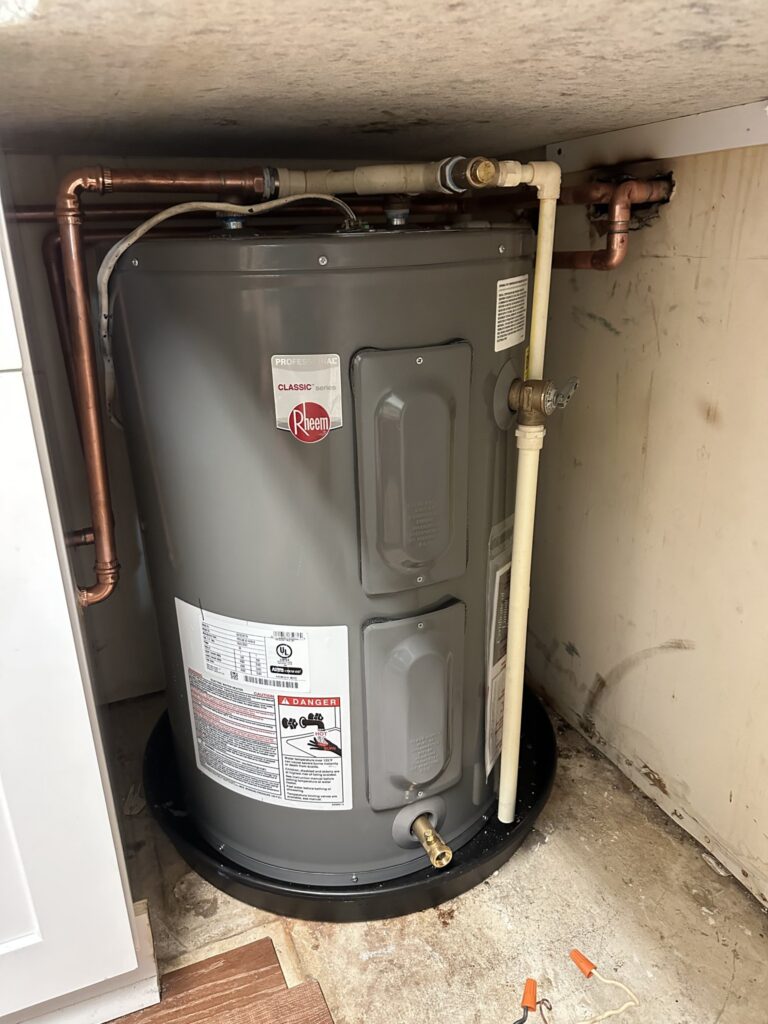
Because this was a like-for-like electric replacement, the electrical stayed as it was: a dedicated 30-amp circuit, 10-gauge wire, which matches what NFPA 70[8], the National Electrical Code, calls for in Article 422 for a standard 4,500-watt element heater. I checked the connections in the junction box on top anyway. Loose connections there are the other reason breakers trip, and I would rather find that on install day than on a callback.
She asked, while we were waiting on the parts run, whether this was the moment to switch to a hybrid. In a garage like hers it can be, and I wrote about what a heat pump water heater actually did to a Palm Coast family’s FPL bill, but a Saturday with wet drywall is not the day to add a week of lead time. The whole job, from the first text to hot water, was about six hours including the parts run. That is not always possible. I mention it because when people ask whether a bottom leak is an emergency, the honest answer is that the leak itself is slow and quiet, but the damage it causes is not, and the difference between a same-day swap and a Monday swap can be a drywall repair.
The insurance question she asked while I was loading the old tank
She asked whether her homeowners policy would pay for any of it. I am not an adjuster, but I have been on enough of these to know what the adjuster asks for. Under Florida’s water-damage claim provisions in Statute 627.7011[9] and the reforms in SB 2-A[10], insurers have gotten stricter about sudden-versus-gradual damage and about the age of the equipment that failed. A tank that failed from age and corrosion is usually treated as maintenance, which means the heater itself is on you. The resulting water damage to the wall and floor may be covered if it was sudden, which is why the photos matter. Take pictures of the puddle, the tank’s rating plate, and the wet drywall before anything is cleaned up. Keep the invoice. The Citizens Property Insurance four-point inspection form[11] also asks about water heater age at renewal, which is a separate topic I cover in the post about four-point inspections and water heaters in Flagler County, and one worth reading if your tank is over ten years old and you have not had a renewal letter yet.
What people usually ask me at this point
Can a leaking water heater be repaired? If the leak is at a fitting, the T&P valve, or the drain valve, yes, and it is a small job. If the water is coming from the tank body, no. There is no patch for a rusted-through steel tank, and anyone offering one is selling you a few weeks.
Is a leaking water heater dangerous? The water is not, but an electric element running dry is, and standing water near the electrical junction on top of the tank is. Kill the breaker first. On the rare gas heater in this area, a leak near the burner compartment is a reason to shut the gas valve and call.
How do I turn it off if it is leaking? Breaker off, then the cold-water valve on the tank, then the main if that valve will not turn. Open a hot tap somewhere in the house to relieve pressure. That is the whole procedure.
Does insurance cover it? Usually the damage, not the appliance, and only if it was sudden. Photos and the tank’s age decide most of it.
If you want the wider picture, every decision from that garage sits inside the full guide built from one week of Palm Coast water heater calls, which walks four different tanks in order.
What I want you to take from that Saturday
The water on the floor was the least important thing in that garage. The age of the tank, the dry anode, and the pan with no drain line had been telling the story for years. If your heater is past ten and sits in a garage on Palm Coast city water, walk out there this week with a flashlight and look at the bottom seam and the pan. A dry pan and a clean seam mean you have time to plan a replacement on your own schedule, which is always cheaper than one on a Saturday morning. A stained seam means you are where she was, minus the puddle.
That is the difference between minutes and days, and it is the reason I would rather look at a tank a year early than a day late. If you want a second set of eyes on yours, the water heater leaking from the bottom question is one of the most common reasons people reach us, and our water heater installation and repair service in Palm Coast is set up for same-day swaps when the tank is the problem.
Sources
- U.S. Consumer Product Safety Commission: water heater safety
- Rheem: water heater manuals and serial-number date codes
- A. O. Smith: water heater serial-number date codes
- Bradford White: water heater serial-number date codes
- City of Palm Coast Annual Water Quality Report (Consumer Confidence Report)
- USGS Water Science School: Hardness of Water
- Florida Building Code, Plumbing (8th Edition, 2023), Florida Building Commission
- NFPA 70, National Electrical Code, Article 422
- Florida Statutes 627.7011
- Florida Senate: SB 2-A (2022 Special Session A)
- Citizens Property Insurance Corporation: Four-Point Inspection form