

What Do Insurers Look for in Shut-Off Valves During a Four-Point Inspection of a Palm Coast Home?
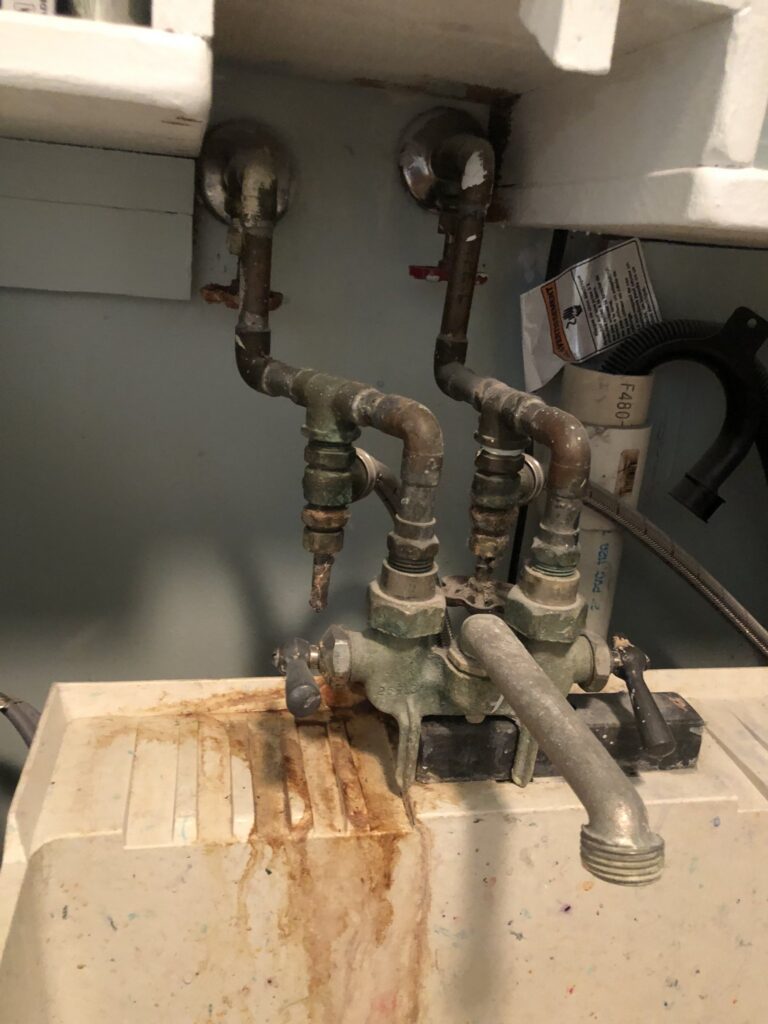
- A four-point inspector is looking at whether the water can be shut off, at the fixture and at the house. A valve that will not turn, or that leaks when turned, gets written up.
- In 1980s Palm Coast houses the original multi-turn gate valves and compression stops are usually corroded solid. That is the finding I fix most.
- Eleven quarter-turn ball-valve stops and a new main ball valve took one morning. The re-inspection photo needed to show each one, open, dry, and labeled.
- What fails a policy and what merely gets noted are different things. Ask the inspector which one you have before you panic.
The situations described here are composites drawn from the types of jobs and decisions we encounter regularly. Names and specific figures are illustrative.
The letter gave him thirty days. His carrier had ordered a four-point on the 1988 house in Palm Coast’s C-section as a condition of renewal, and the plumbing page came back with a list: corroded gate valves under every sink, a main shut-off that the inspector could not turn, and a photograph of a green-crusted angle stop under the kitchen sink that looked like it had been there since the house was framed. He wanted to know what the underwriter was actually looking for in the shut-off valves during a four-point inspection, and whether fixing eleven little valves was going to save a policy. It was, and it did, and the whole job took a morning.
This post is that four-point from the letter to the re-inspection photos, what the inspector was checking and why, and the difference between a finding that fails a policy and one that gets a note.
What a four-point is, and why the valves matter to it
A four-point inspection is the short report Florida insurers require on older homes, usually anything past twenty-five or thirty years, covering roof, electrical, HVAC, and plumbing. It is not a home inspection; it is a risk snapshot for an underwriter who will never see the house. The plumbing section on the Citizens Property Insurance[1] four-point form, which most carriers either use or copy, asks about the supply and drain materials, the water heater’s age, evidence of leaks, and the condition of the shut-off valves. The Florida Office of Insurance Regulation[2]‘s consumer guidance on the inspections is worth reading once, because it explains that the form drives the underwriting decision and the inspector is documenting, not judging.
Why valves? Because a water loss is the most common homeowners claim in Florida, and the size of a water loss depends on how fast the water gets shut off. A house where the main will not turn and the fixture stops are seized is a house where a burst supply line runs until a plumber arrives. The underwriter reads a seized main as a bigger claim waiting to happen, and prices or declines accordingly.
What was under his sinks
The house had its original 1988 valves. Under each sink and behind each toilet, a chrome-plated brass multi-turn compression stop, the kind with a small oval handle you turn several times to close. Thirty-six years of Palm Coast water, which is hard and slightly corrosive to brass, had done two things: scaled the stem so the handle would not turn, and eaten the packing so that when it did turn, it wept at the stem. Three of the eleven turned. Two of those three dripped when they did. The other eight were seized. The inspector had tested one, found it stuck, photographed it, and moved on, which is the right call; forcing a seized stop is how you snap it off and flood the cabinet.

The main shut-off was a gate valve, the wheel-handled type with a brass gate that drops into the flow. It was at the front hose bib where the supply comes up from the meter, exposed to salt air off the coast, and the wheel would not budge. Gate valves fail two ways here: the stem seizes, or the gate corrodes and drops off the stem so the wheel spins freely and shuts nothing. Either way the house cannot be isolated without going to the meter at the street, and the meter valve belongs to the city.
The morning, in order
Water off at the meter, with the curb key, since the house main did not work. Drained the system at the lowest hose bib. Then the main first: cut out the gate valve and installed a full-port brass ball valve, quarter-turn, lever handle, with a union so the next plumber does not have to cut anything. Ball valves have a polished ball with a hole through it; a quarter turn opens or closes, there is no packing to dry out, and nothing to seize. The Florida Building Code, Plumbing[3] edition requires a full-way valve on the water service to each building, and a ball valve is what everyone installs to meet it now.
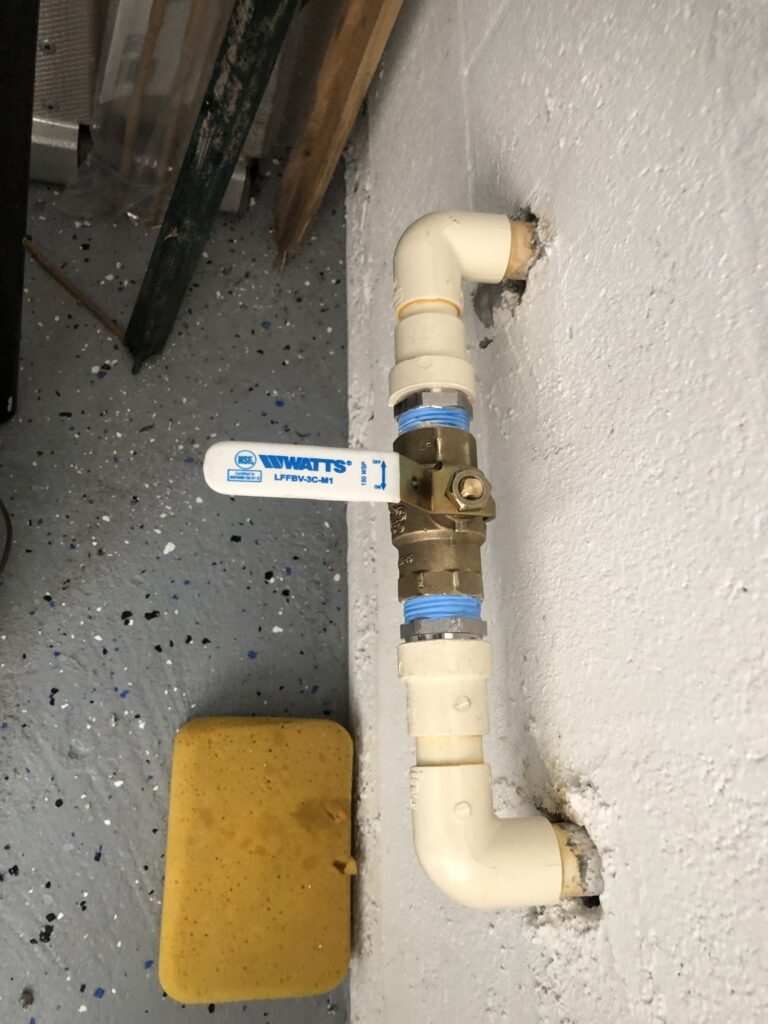
Then the eleven stops, two per vanity, one per toilet, two at the kitchen, one at the fridge line, one at the laundry. Each one: cut the old compression stop off the copper stub, clean the stub, install a quarter-turn ball-valve angle stop, new braided stainless supply line to the fixture. The supply lines were as old as the stops, and a new stop feeding a 1988 braided line is half a job. Turned the water on at the meter, opened each stop, checked each connection dry, and then, the part that matters for the underwriter, photographed each one.
What the re-inspection photo needs to show
An underwriter reviewing a remediation wants to see the finding resolved, not described. I photograph each new valve in place, open, with the fixture connection visible and dry, and I label each photo by location. Kitchen hot, kitchen cold, hall bath toilet, and so on. The main gets a photo showing the new ball valve, the union, and the lever, plus a short video of it turning closed and open. I send the set to the homeowner with the invoice, which describes the work as replacing all original shut-off valves with quarter-turn ball valves and the main with a full-port ball valve, and lists the count. His agent forwarded the invoice and photos to the carrier, and the policy renewed without a re-inspection visit, which is common when the documentation is clean.
The invoice language matters more than people think. An invoice that says repaired plumbing does nothing for an underwriter. One that names the finding on the four-point and states that it was corrected, with photos, closes it.
What fails a policy and what does not
This is the question he asked first and the one I answer most. Findings that carriers treat as decline-or-fix: polybutylene supply piping, active leaks, a water heater past a certain age or with visible corrosion, and a main shut-off that does not work. Findings that usually get a note and a rate, not a decline: seized fixture stops, a slow drip at a stop, older but functioning valves, galvanized drain lines. His had one from the first list, the main, and eleven from the second. Fixing only the main might have satisfied the carrier. Fixing all of them cost a little more that morning and means the next four-point, and the one after that when he sells, has nothing on the plumbing page.
The insurance market shifted after the SB 2-A[4] reforms in 2022 and the follow-on legislation in 2023. Carriers are stricter on four-points than they were, and a house that would have been written with notes five years ago now gets a fix-or-decline letter. The thirty-day window is standard and it is real; I have had customers call on day twenty-eight.
What people ask holding the letter
What does a four-point inspection check on plumbing? Supply and drain materials, water heater age and condition, visible leaks, and whether the shut-off valves work.
Do shut-off valves fail a four-point? A main that will not turn can. Seized fixture stops usually get noted. Either way, fixing them is a morning.
What is the difference between a gate valve and a ball valve? A gate valve turns several times and seizes or drops its gate with age. A ball valve turns a quarter and does not.
How much does it cost to replace shut-off valves? Per stop, it is a modest parts-and-labor item. The main is more. On this house all twelve, with supply lines, was one morning’s labor plus parts, with the $96 service call applied.
What if I can’t find my main shut-off? That is the post on where the main water shut-off valve is in a Florida house, written after a snowbird’s neighbor could not find one.
The same seized stops are why a toilet repair sometimes stops before it starts, in the post on why a toilet keeps running after a new flapper, and why I replace the stops when I swap a faucet, in the post on whether to replace the cartridge or the whole faucet. The valve that would not shut off from the week in the guide to common household plumbing problems in Palm Coast is this one, and the invoice for it is on the tailgate in the post on what five Palm Coast service calls actually came to.
What the C-section house has now
Twelve lever handles that turn with two fingers, a union at the main, and a folder of labeled photos he will hand to the next inspector and, eventually, the next buyer. The policy renewed. The next four-point will have a plumbing page with nothing on it but a water heater date, which is the goal on a house from 1988.
If a letter has you searching for what the underwriter wants in the shut-off valves during a four-point inspection, the answer is that they turn, they hold, and there is a photo. Our plumbing repair and service in Palm Coast replaces the stops and the main in a morning, documents each one for the carrier, and applies the $96 service call to the work.