

Is a Heat Pump Water Heater Worth It in Florida, or Did a Palm Coast Family Just Buy a Noisy Dehumidifier?
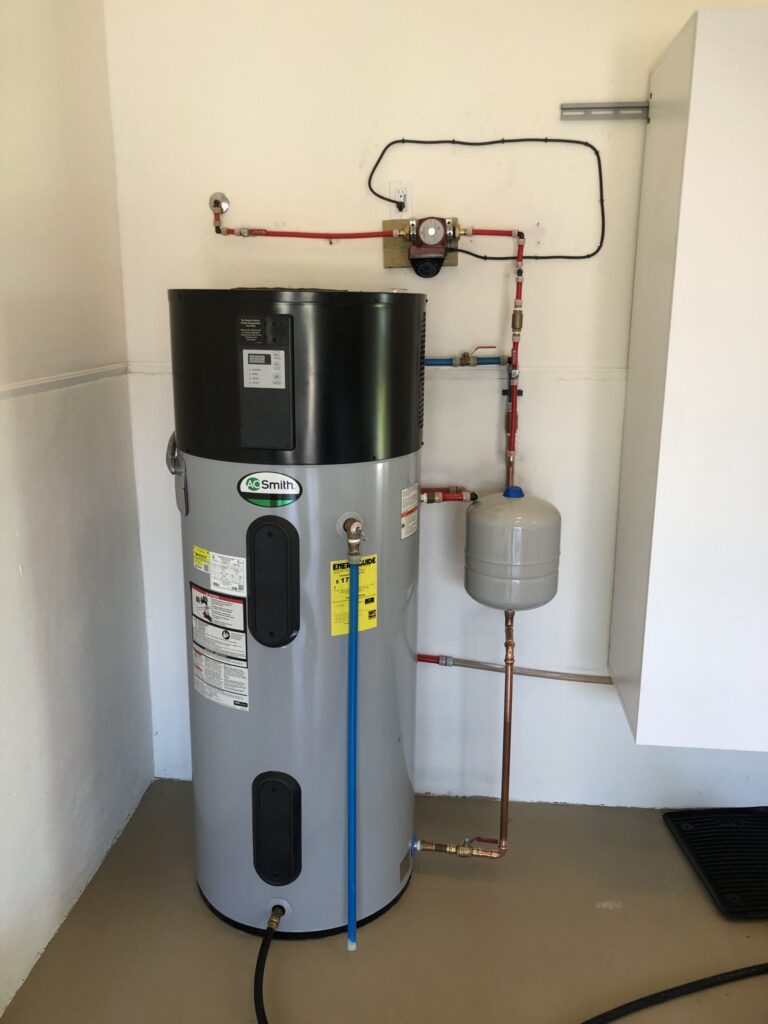
- A hybrid pulls heat out of garage air, which Palm Coast has in surplus nine months a year. That is why the savings here are real and the savings in Ohio are theoretical.
- The first month brought two complaints: a compressor hum and a garage that felt like a different room. One was a placement fix. The other was a feature.
- The two FPL bills after the swap showed the water-heating share of the bill dropping by roughly two-thirds. The payback math still depends on how long you keep the house.
- The federal tax credit is gone. What is left is the FPL bill, and that is enough for some households and not for others.
The situations described here are composites drawn from the types of jobs and decisions we encounter regularly. Names and specific figures are illustrative.
The family on Island Estates had a 50-gallon electric tank in the corner of a two-car garage, a fourth kid on the way, and an FPL bill they had started reading line by line. The question they asked was the one I get more than any other from people who have done some reading: is a heat pump water heater worth it in Florida, or is it a gadget that sounds good in a showroom in a state where it does not get hot? I told them what I tell everyone, which is that the answer lives in their garage, not in a brochure. Then we went and stood in it.
This post follows that install from the garage walk-through to the second power bill, including the month in between when they were not sure they had made the right call.
Why the garage is the whole argument
A heat pump water heater does not make heat with a resistance element the way a standard tank does. It runs a small compressor and a fan, pulls heat out of the surrounding air, and moves it into the water. The ENERGY STAR criteria[1] for these units are built around that efficiency, and the U.S. Department of Energy’s 2024 final rule[2] on residential water heater standards, which takes effect in 2029, effectively pushes most new larger electric tanks toward this technology. In a Minnesota basement in January there is not much heat in the air to move. In a Palm Coast garage in July there is more than anyone wants.
Their garage measured 94 degrees at four in the afternoon the day I looked at it, with humidity in the seventies. The unit needs roughly 700 cubic feet of air around it and a temperature range the manufacturer specifies, generally about 40 to 120 degrees. A two-car garage is several thousand cubic feet. Their tank corner had clearance on three sides. It was, in the plain sense, the ideal spot. I have seen these units installed in an interior closet with a louvered door in other homes, and those installs struggle. The compressor pulls the closet down to the point where it spends most of its time in backup electric mode, which is the mode you paid to avoid.
What the install involved that a standard swap does not
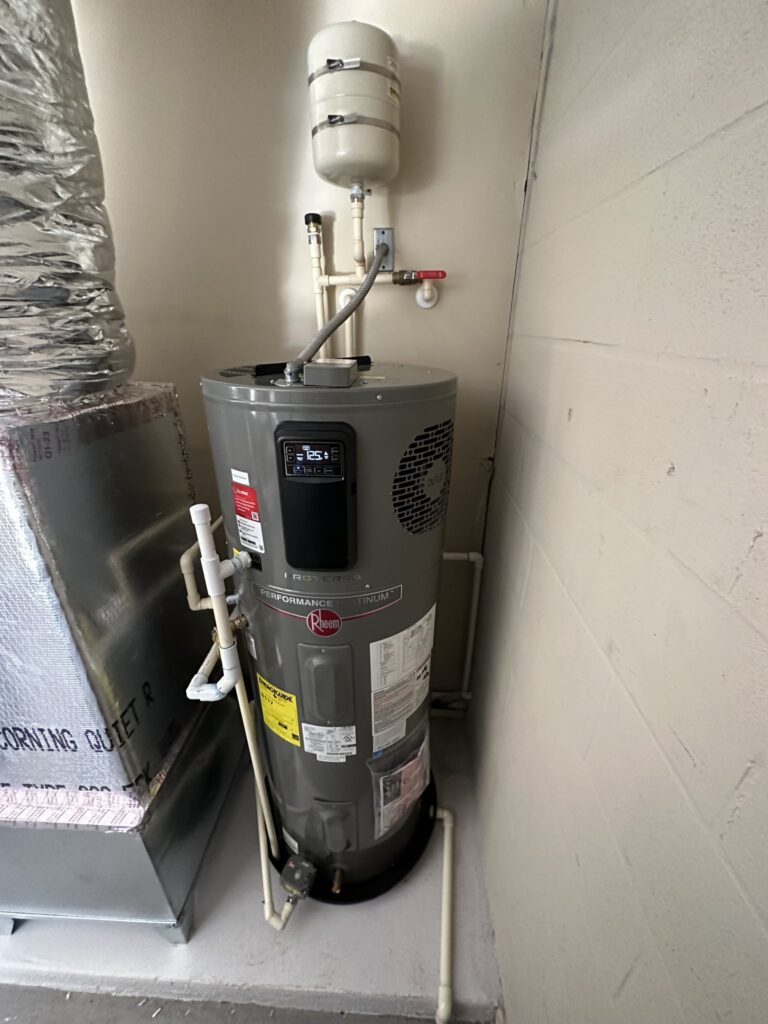
We set a Rheem[3] ProTerra 50-gallon on a new pan with a drain line, the same as any tank. Three things were different. First, the unit produces condensate as it pulls moisture out of the air, and that has to go somewhere. Their garage had a floor drain near the water heater corner, which is uncommon here; on most slab homes I run the condensate line to the exterior with a small pump or a gravity line through the wall, and the manufacturer’s manual is specific about trap and slope. Second, the unit is taller than a standard 50-gallon tank because the compressor sits on top. We measured the ceiling and the garage door track before ordering. Third, the electrical stayed the same: the ProTerra runs on the existing 30-amp, 240-volt circuit that NFPA 70[4] Article 422 requires for a resistance heater, because it keeps resistance elements as backup. No panel work.

We added a thermal expansion tank, which their old install had never had, and left the unit in its default heat pump mode with the thermostat at 120 degrees, which is where the CDC’s scald guidance[5] and the efficiency both land.
The first month, and the two phone calls
The first call came four days in. The compressor makes a hum and a fan noise, something like a window air conditioner on low. In a detached garage nobody notices. Their garage shares a wall with the laundry room and the primary bedroom closet, and at night with the house quiet they could hear it cycle. I went back out and looked at the placement. The unit was sitting directly against the shared wall. We moved it eighteen inches out and set it on a rubber isolation pad. That took most of the transmitted noise out of the wall. The fan noise itself did not change; it is a specification, not a defect, and the manufacturer publishes the decibel rating.
The second call came at the end of week two. The garage felt different. Cooler, and noticeably less damp. The chest freezer was not sweating. That is the unit pulling heat and moisture out of the air and dumping it into the water, and it is why I tell people a hybrid in a Palm Coast garage is a small dehumidifier you get for free. The condensate line was running a slow, steady trickle. That call was not a complaint, once we talked it through. But it was a surprise, and surprises are the reason I now walk people through both effects before the install rather than after.
The two FPL bills, side by side
They shared their bills, which is the only reason I can write this section with numbers instead of manufacturer claims. Their pre-swap summer bill ran around 1,950 kilowatt-hours for the month. Water heating for a family of five with a resistance tank is commonly a fifth of household electric use, which put their water-heating share somewhere near 400 kilowatt-hours. The first full month after the swap came in around 1,690 kilowatt-hours with no other changes they could name, and the second month was within thirty of that. Call it a 260-kilowatt-hour drop, which is roughly two-thirds of what they had been spending on hot water.
At the residential rates on FPL[6]‘s current tariff, that came to a little under $40 a month. The installed cost difference between the hybrid and a like-for-like electric tank on their quote was about $1,400. That is a three-year payback, before any rebate, and a unit with a ten-year tank warranty. The math works for them. It works less well for a retired couple who use half the hot water, and I have told those couples exactly that.
The rebate conversation, honestly
The federal 25C tax credit that covered a portion of heat pump water heaters ended for installs after 2025. IRS Form 5695[7] and its instructions confirm the expiration. I still get asked about it every week, and the answer is that it is gone and the payback has to stand on the FPL bill alone. FPL’s own rebate programs change year to year; at the time of this install there was no active residential rebate for heat pump water heaters, and I check before every hybrid quote because it changes the number. Without a rebate, the three-year payback above is the real one.
What people ask me when they are deciding
Where should it go? A garage with clearance on three sides, at least 700 cubic feet of air, away from a shared bedroom wall or on an isolation pad if it has to be near one. Not a closet, not a utility room with a solid door.
How much does it save per month? For a household that uses a lot of hot water, in this climate, roughly two-thirds of the water-heating portion of the bill. For a light user, less in dollars because there is less to save.
Is it noisy? It hums and has a fan, at a published decibel level similar to a small window unit. Placement decides whether you hear it inside, and moving one off a shared wall is a short visit under our plumbing repair service in Palm Coast.
Is it the right choice if my tank is leaking right now? Usually not on the same day. Hybrids are sometimes a special order, and a tank that is leaking is the situation I wrote up in the post about a Saturday puddle under a Palm Coast water heater, where speed wins. If your tank is healthy and you are planning ahead, the timing works.
How does it compare to tankless? That question came up in a different house, and the answer surprised the couple who asked it. I covered it in the post on tankless versus tank water heaters in an all-electric Palm Coast home. The short version is that their panel decided it.
The hybrid is one of three options, and I lay all three out against real Palm Coast houses in the full guide built from one week of Palm Coast water heater calls.
Where they landed, and where I did
Six months in, they have stopped hearing the hum, the garage is the driest room in the house, and the bill has stayed down. If I am honest, the thing that made it work was not the technology. It was a garage that happened to be the right size, in a climate that happens to be the right temperature, in a house that happens to use a lot of hot water. Change any one of those and the same unit is a harder sell.
So when someone asks whether a heat pump water heater worth it in Florida, I ask to see the garage first. The itemized water heater quote I send afterward shows the hybrid and the standard tank as two separate line-item totals, and our water heater installation and repair service in Palm Coast installs both. The number that matters is the one on your bill, and I would rather you get it from your own house than from mine.
Sources
- ENERGY STAR: Heat Pump Water Heaters
- U.S. Department of Energy, Appliance and Equipment Standards: Residential Water Heaters (2024 final rule)
- Rheem: water heater manuals and serial-number date codes
- NFPA 70, National Electrical Code, Article 422
- CDC: scald prevention and water heater temperature
- FPL residential rates and tariffs
- IRS: About Form 5695, Residential Energy Credits