

How Long Do Water Heaters Last in Florida When the Garage Hits 95 Degrees and the Water Runs 11 Grains Hard?
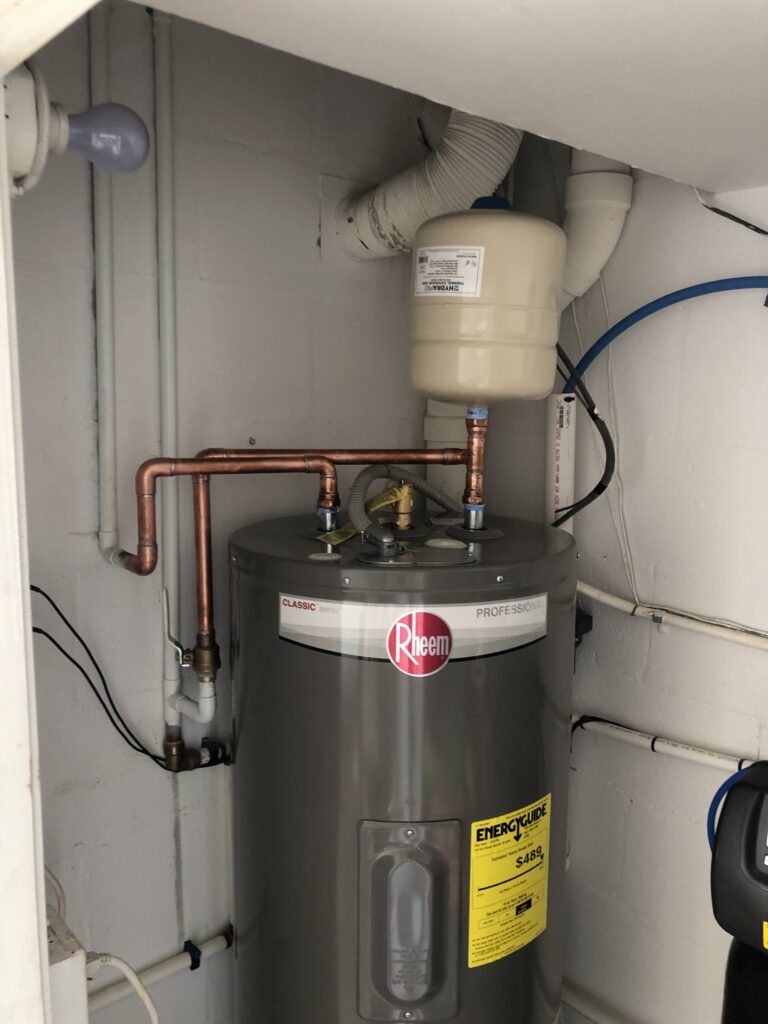
- The 10-to-12-year rule on the box assumes soft water and a conditioned space. Palm Coast city water and a garage install take two to four years off that.
- The sacrificial anode rod is what protects the steel once the glass lining cracks. On unserviced tanks here it is usually gone by year four or five.
- Your tank’s age is in the serial number. Decode it before an insurer or an inspector does it for you.
- The difference between an eight-year tank and a fourteen-year tank on the same street came down to three things, none of them the brand.
The situations described here are composites drawn from the types of jobs and decisions we encounter regularly. Names and specific figures are illustrative.
Two houses on the same street in Flagler Beach, built the same year by the same builder, with the same 40-gallon electric water heater in the same garage corner. One tank died in August at eight years old. The neighbor’s is on year fourteen and still holding. The homeowner with the dead tank asked me the question I hear most: how long do water heaters last in Florida? The honest answer is that it depends on three things you can see from the driveway, and the two tanks side by side are the clearest way I know to explain them.
I got to look at both. The neighbor was curious enough to open her garage. What follows is what I found, and what I would do with a tank that is somewhere between those two ages.
Reading the rating plate before anything else
The first thing I do on any heater call is find the rating plate and decode the serial number. Every manufacturer buries the manufacture date in there. Rheem[1]‘s format puts the month and year in the first four characters. A.O. Smith[2] and Bradford White[3] use letter codes for the year and month that you need their published date-code guides to read, and I keep those on my phone. The dead tank decoded to eight years and two months. The neighbor’s decoded to fourteen years and change. Same model line, two years apart in production, six years apart in life.
This matters beyond curiosity. Insurers ask for the age on a four-point inspection, and the Citizens Property Insurance form has a line for it. Knowing the number before the inspector shows up lets you plan instead of react. I wrote about that renewal-letter scramble in a post on what a four-point inspection checks on a water heater, and most of those calls start with a homeowner who did not know their tank was fifteen.
What the water is doing inside both tanks
Palm Coast pulls its water from the Floridan Aquifer through the city’s treatment plants, and the City of Palm Coast Annual Water Quality Report[4] publishes the hardness. The number moves a little year to year, but it sits in the range the USGS classification[5] calls hard to very hard, roughly eleven grains per gallon when I test at the hose bib. UF/IFAS Extension[6]‘s home water quality series explains what that means in plain terms: calcium and magnesium carbonate that comes out of solution when the water is heated. In a water heater, that is the bottom of the tank.
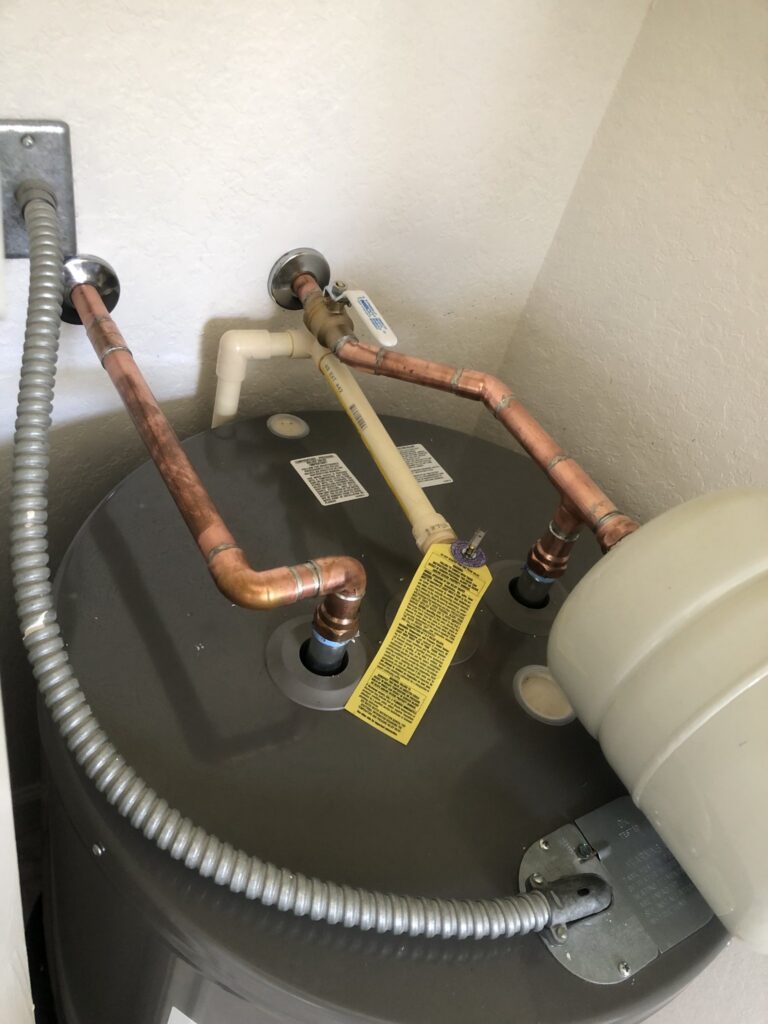
Sediment does two things. It insulates the bottom of the tank from the water, so the lower element in an electric heater runs longer and hotter to do the same job, and the steel under the sediment cycles through more heat than it was designed for. That thermal cycling is what cracks the glass lining. The second thing sediment does is trap water against the steel in a stagnant layer, and stagnant hot water against steel is corrosion. Both tanks had the same water. The difference was what had been done about it.
The neighbor flushed her tank every spring. She had a hose on the drain valve and a routine. The dead tank had never been flushed in eight years. When I drained it, the first two gallons came out the color of coffee with cream, and the bottom held an inch of hard scale I could hear when I rocked the tank.
The anode rod, which is the whole story on most tanks here
Inside every glass-lined tank is a magnesium or aluminum rod threaded into the top. It exists to corrode instead of the tank. Once the lining cracks, which it will, the anode is the only thing standing between water and bare steel. Manufacturer manuals say to inspect it every few years. Almost nobody does.
I pulled the anode on the dead tank before we hauled it. It was a bare steel wire with a few pits of magnesium clinging to it. It had probably been that way since year four or five. After that, the tank was corroding on the clock. The neighbor’s anode, which I pulled with her permission, was about forty percent consumed at fourteen years. She had replaced it once, at year seven, on the advice of whoever installed it. That one part, which costs less than a service call, is most of the six-year difference.
Hard water eats anodes faster because the mineral content raises the conductivity of the water. Salt air, which both garages get since they face the ocean side of A1A, corrodes the fittings and the jacket from the outside but does not touch the anode. It does, however, shorten the life of the T&P valve and the top connections, which is where the first exterior rust shows on barrier-island tanks. NOAA and Florida Sea Grant[7] publish material on salt-aerosol corrosion near the coast, and the practical version is that anything steel within a mile of the beach ages faster than the same part in Bunnell.
The garage, and why the box’s number is optimistic
The rated lifespan on a water heater assumes the tank sits in a conditioned space. Most Palm Coast tanks sit in a garage that hits the mid-nineties every afternoon from May through September. Heat is not a direct killer of tanks the way it is of heat pump compressors, but it accelerates every chemical process inside, including corrosion, and it shortens the life of the plastic drain valve and the dip tube. Both tanks were in garages. The neighbor’s garage has a window unit she runs in summer because she keeps a chest freezer out there. It is not why her tank lasted longer, but it did not hurt.

If you are choosing a replacement for a hot garage, that same heat becomes an advantage for a hybrid heat pump unit, which pulls warmth from the air to heat the water. I wrote up a real install and the FPL bills that followed in a post on whether a heat pump water heater is worth it in Florida. For a standard electric tank, the garage is simply where it lives, and the number on the box is the best case.
What the dead tank looked like in its last year
The homeowner had noticed things without connecting them. The hot water had been running out sooner, which is sediment taking up tank volume. There was a popping sound when the tank heated, which is water boiling under the sediment layer. The water had a faint rust tint first thing in the morning, which is the lining letting go. And the T&P valve had started to weep, which he had fixed with a bucket. Each of those is a sign, and each is covered in the leaking-tank post I wrote about a Saturday puddle under a garage water heater in Palm Coast. Together, at eight years, on this water, they are a replacement conversation.
He asked whether he should have replaced it at seven. Probably not. He should have flushed it and changed the anode at four, which would have bought him the neighbor’s six extra years for about the cost of one service call. That is the part that stings, and it is why I tell people the box number is not a prediction. It is a ceiling.
The questions I get on this every week
How do I tell how old my water heater is? Find the rating plate, usually a sticker on the side of the jacket, and photograph the serial number. Each brand’s date-code guide is published and easy to find, or send me the photo and I will decode it.
Does hard water shorten water heater life? Yes, through sediment and faster anode consumption. On Palm Coast city water, plan on eight to ten years for an unserviced tank and twelve to fifteen for one that gets flushed and gets a new anode around year five. A softener changes that math, which is part of why so many homes here end up with one; our whole-house filtration and softening service page covers the options.
Should I replace a ten-year-old water heater? Not automatically. Pull the anode and look at the bottom seam. If the anode has metal left and the seam is clean, service it and plan for replacement in two or three years. If the anode is bare wire, the tank is on borrowed time regardless of how it looks outside.
What are the signs it needs to be replaced? Rust-tinted hot water, popping during heating, hot water running out faster than it used to, moisture at the base or the bottom seam, and a T&P valve that weeps after the pressure has been checked. Any two together on a tank past eight is my threshold.
Both of these tanks are one chapter of a longer story. The full guide built from one week of Palm Coast water heater calls covers what happens after the age question: type, insurance, and cost.
What I told both neighbors
The one with the dead tank got a new 40-gallon electric on a pan with a drain line, and a note on his calendar for a flush next spring and an anode check at year four. The neighbor with the fourteen-year tank got a new anode rod, because forty percent left at fourteen years means she is closer to the end than the beginning, and a suggestion to start pricing a replacement on her own schedule rather than a Saturday morning’s.
That is the real answer to how long do water heaters last in Florida: as long as you let it, within limits the water sets. If you want to know where yours stands, the serial number and a look at the anode take about twenty minutes, and our water heater installation and repair service in Palm Coast does that check as part of any service call.
Sources
- Rheem: water heater manuals and serial-number date codes
- A. O. Smith: water heater serial-number date codes
- Bradford White: water heater serial-number date codes
- City of Palm Coast Annual Water Quality Report (Consumer Confidence Report)
- USGS Water Science School: Hardness of Water
- UF/IFAS Extension (EDIS): Home Water Quality series
- NOAA / Florida Sea Grant: coastal corrosion