

What Was Really Behind Low Water Pressure in Palm Coast, FL When the Homeowners Were Ready to Buy a Booster Pump?
The situations described here are composites drawn from the types of jobs and decisions we encounter regularly. Names and specific figures are illustrative.
A couple in a 2005 block house in Cypress Knoll asked us to quote a booster pump. They had lived with low water pressure in Palm Coast, FL for most of a year, it had gotten worse since spring, and they had read enough online to decide a pump was the answer. They already had a pump picked out, and with a tank, wiring and tie-in it would have cost more than $1,500 installed. I asked if I could put a gauge on the house first. It costs nothing extra on a $96 service call, and it decides whether a pump is even on the table.
This is the order I work through when a house feels weak, why it matters in Palm Coast specifically, and what the gauge showed at this house.
What they had already decided before I got there
Their reasoning was not unreasonable. The master shower was the worst of it, but the kitchen sink took longer to fill a pot than it used to, and when the dishwasher ran the shower nearly quit. They assumed the city had lowered pressure in their section, and a pump seemed like a fix they could control.
The trouble with that plan is that a pump adds pressure to whatever arrives at the house. If the water is arriving fine and being choked somewhere between the meter and the fixtures, the pump pushes harder against the same restriction, runs more often, and adds a motor and a tank to the garage that need service of their own. Before anyone spends that money, the question is simple: is the water low when it gets to the house, or does it get low after?
Where the gauge goes and what the numbers meant
A pressure gauge threads onto a hose bib like a garden hose. You can buy one at a hardware store and do this yourself. The first reading is static pressure, with nothing in the house running. The second is with a couple of fixtures open, which tells you how much the pressure falls under normal use. A house that reads low on both has a supply problem. A house that reads fine when nothing is running and collapses when the shower and kitchen open together has a restriction somewhere inside its own plumbing.
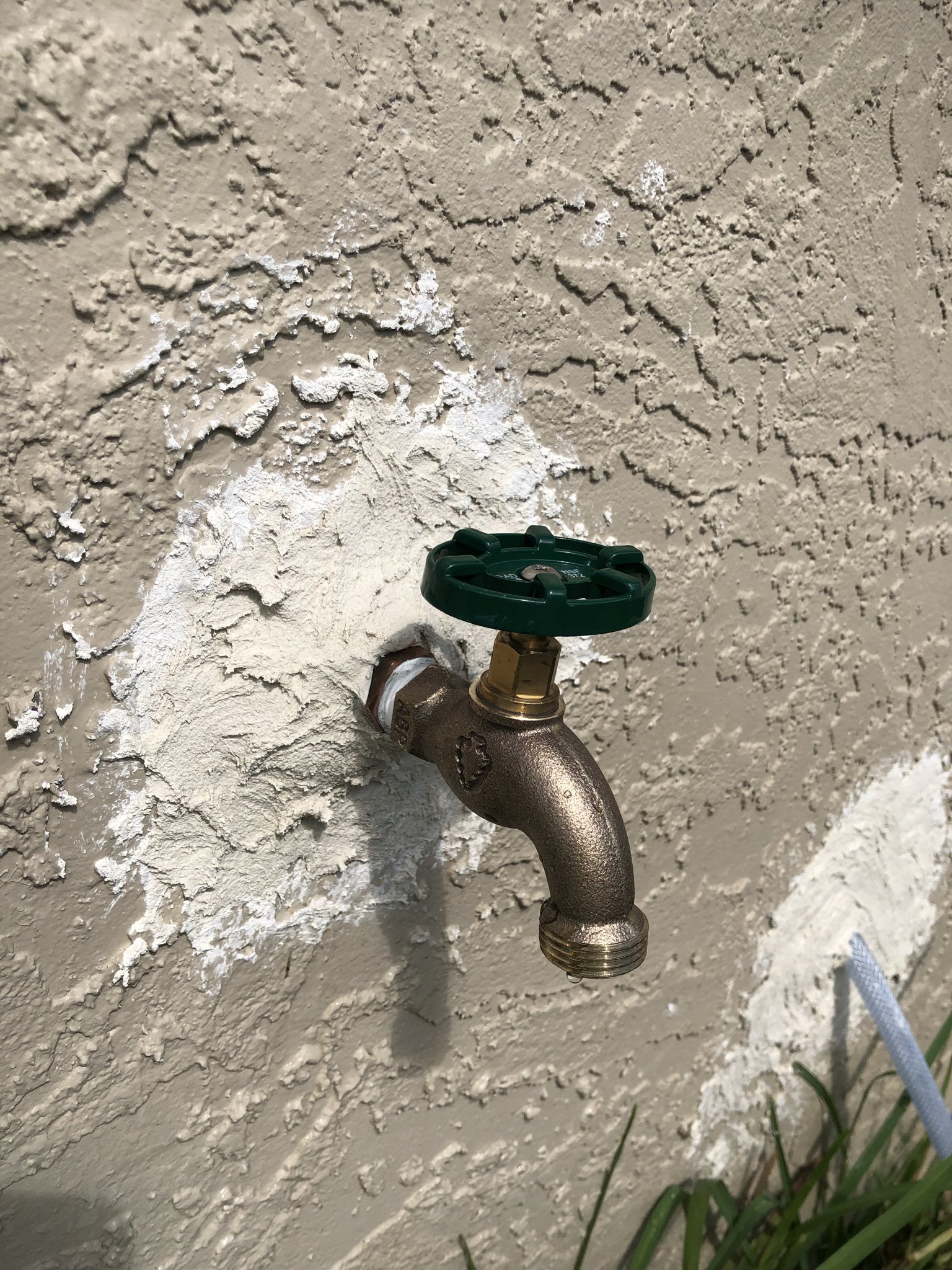
This house had two hose bibs, and that turned out to matter. The one at the front corner is plumbed before the pressure-reducing valve, the PRV, because the builder ran the irrigation tee off the main before it entered the garage. The one on the back patio is after it. So I read both. The front bib showed what the city was delivering. The back bib showed what the house was getting.
Here are the readings.
| Reading | Front bib (before the PRV) | Back bib (after the PRV) |
|---|---|---|
| Static, nothing running | 68 psi | 41 psi |
| Shower and kitchen open | 63 psi | 14 psi |
| After the new PRV, shower and kitchen open | 63 psi | 47 psi (static set at 55) |
The city side barely moved when the fixtures opened. The house side fell by two-thirds. That ruled out the utility, the meter, and the neighborhood in about ten minutes, and it ruled out the pump. The water was getting to the house fine. It was losing its pressure inside one bronze valve in the garage.
What was inside the pressure-reducing valve
A PRV is a spring-loaded valve that takes whatever the street delivers and steps it down to a set pressure for the house. It protects the fixtures from street pressure that swings during the day. The Department of Energy’s Building America guidance recommends keeping static service pressure in a house at 60 psi or below for exactly that reason. A PRV does not last forever, and it fails in one of two directions. Failing high is harder to notice: everything still works, and supply lines and toilet fill valves wear out early. Failing low is the one people notice, because the shower gets weak.
This one was original to the house, so about twenty years old. Most PRVs have a small screen on the inlet side, and this screen was packed with grit and scale. The diaphragm had also stiffened enough that the valve was not opening fully when demand went up. Cleaning the screen would have bought some time. On a twenty-year-old valve with a tired diaphragm, I did not think it would buy much, and I said so. We replaced it with a new lead-free PRV with an integral strainer, added a union on each side so the next replacement is a short job, and set it at 55 psi with the gauge on the back bib.
One thing worth knowing if your house gets the same repair: when a stuck PRV is replaced and full flow comes back, it tends to push loose scale downstream. The master showerhead had a fine screen in the inlet that was half blocked by the next morning. Unscrewing the head, rinsing the screen and putting it back took five minutes, and after that the shower ran the way it should have all year.
Why this shows up so often in Palm Coast houses
Two things make this a common call here. The first is the water. Palm Coast city water is hard by the USGS definition, as the city’s own water quality reports show, and the mineral scale collects wherever water slows down or squeezes through a small opening: PRV screens, aerators, showerhead screens, cartridge valves. The second is the housing stock. A large share of the city was built in two waves, the ITT years and the production-builder boom of the late 1990s and 2000s. The second wave put PRVs on a lot of houses at once, and those valves are now reaching the age where they fail.
There is also a part of the system that belongs to the city and a part that belongs to you. The City of Palm Coast Water Distribution Division maintains the water lines, isolation valves and meters. Everything on the house side of the meter, including the PRV, the main shut-off and every pipe after it, is the homeowner’s. That is why the two-gauge test is so useful. It tells you which side of that line the problem is on before you call anyone.
If the front reading had been low too, the next call would have been to the city, not to a plumber. Palm Coast Connect has a “No Water / Low Pressure” case type for exactly that, and it is the right place to start if your neighbors are seeing the same thing.
Where weak pressure shows up, and what it usually means
Not every weak shower is a PRV. Before the gauge comes out, where the problem shows up narrows it down a lot. This is the rough map I work from on a service call.
| Where it is weak | What it usually points to | Who handles it |
|---|---|---|
| One faucet or one showerhead | Scaled aerator, clogged showerhead screen, or a worn cartridge | Often the homeowner; a cartridge may be a service call |
| Hot side only, everywhere | Water heater inlet or outlet restriction, or a partly closed valve at the heater | Plumber |
| Whole house, worse when two fixtures run | Failing PRV, partly closed main shut-off, or a clogged whole-house filter | Plumber, after a gauge test |
| Whole house and the neighbors too | Main break, flushing or work on the city side | City of Palm Coast utility |
| Gradual drop plus a rising water bill | A leak somewhere after the meter | Plumber, starting at the meter |
That last row deserves its own mention. Water escaping through a hidden leak is water that is not reaching your faucets, and the water bill usually shows it before you do. The steps for checking that at the meter are in our post on finding where 9,000 gallons went with no visible leak. And in older houses where the pressure is weak because the pipe itself has narrowed or the leaks keep coming back, the conversation eventually turns to a whole house repipe in Palm Coast, which is a different job entirely and not where this house was.
Where the money stopped making sense
The pump they had picked out, plus a pressure tank, a dedicated circuit and the plumbing to tie it in, would have landed somewhere north of $1,500 installed. The PRV replacement with unions and the service call came in under $500. More to the point, the pump would not have fixed it. It would have raised the pressure at the front of the PRV, where there was already plenty, and the tired valve would still have choked the flow on the other side.
There are houses where a booster pump is the right answer. A house on a private well with an undersized pump, or a house at the far end of a long service line where the street pressure really is low, can need one. In both cases the front gauge reading tells you so. What I try to avoid is a homeowner buying the expensive fix for a problem that a ten-minute test would have pointed somewhere else.
I also talked them out of one thing they asked for, which was setting the new valve higher, to 75 or 80, “to make up for the lost year.” Higher pressure feels better in the shower for about a week. After that it shows up as dripping faucets, fill valves that wear out early, and braided supply lines that fail years ahead of schedule. At 55 psi with the valve working properly, the shower felt stronger than it had at any point since they moved in, because the pressure was holding under load instead of collapsing.
“The Department of Energy says to keep the water pressure in a house at 60 psi or below. Go higher than that and you are more likely to end up with dripping faucets, leaking water heaters and burst hoses.”
Christian Laymon, Master Plumber and Owner, Florida Plumbing & Inspection
The questions that came up on the driveway
Most homeowners ask some version of the same questions at this point, and these two were no different.
Would a high-pressure showerhead have helped? Not with the valve failing. A showerhead can only work with the pressure it is given. Federal rules have limited new showerheads to 2.5 gallons per minute since 1994, and WaterSense-labeled heads are rated at 2.0 or less, so a new head is never going to feel like a 1980s one. A good head on a properly working supply feels fine. A good head on a failing PRV feels like the old head on a failing PRV.
Could the whole-house filter they were thinking about buying cause the same problem? It can, if the cartridges are not changed on schedule. A loaded sediment filter restricts flow the same way the PRV screen did, and the symptom is identical: fine when one fixture runs, weak when two do. Our post on what a year of pre-filters looked like in a Palm Coast house shows how fast they load up on city water here. A gauge before and after the filter housing settles it.
How long does a PRV last? Long enough that most people forget they have one. If you have never seen yours, it is usually a bell-shaped bronze valve on the main line near where it enters the garage or the house wall, often just after the main shut-off.
How the house is doing now
Three weeks later the back bib still reads 55 static and holds in the high 40s with the shower and dishwasher running together. They did not buy the pump.
If your house feels weak, the gauge is the cheapest first step there is, whether you put it on yourself or have us do it. A low reading at the bib before the PRV is a call to the city. A good reading before the PRV and a bad one after is a valve. A good reading everywhere and one weak shower is a screen or a cartridge. Each has a different fix and a very different price. For more on the everyday repairs that make up most service calls here, our guide to the common household plumbing problems in Palm Coast walks through a full week of them.
Finding the cause of low water pressure in Palm Coast, FL is usually a short, ordinary visit, and the fix is usually smaller than the one people have already priced. If you’re looking for plumbing repair and service in Palm Coast, you can reach out here.
Sources
- Service Water Pressure, Building America Solution Center, U.S. Department of Energy / Pacific Northwest National Laboratory
- Water Distribution, City of Palm Coast Utility Department
- Water Quality Reports, City of Palm Coast Utility Department
- Hardness of Water, USGS Water Science School
- Palm Coast Connect: Create a Case (No Water / Low Pressure), City of Palm Coast
- Best Management Practice #7: Faucets and Showerheads, U.S. Department of Energy Federal Energy Management Program
- WaterSense Specification for Showerheads, Version 1.1, U.S. Environmental Protection Agency