

How Do You Maintain New Bathroom Fixtures After a Remodel in Palm Coast’s Salt Air and Hard Water?
- Eleven grains of hardness and salt air will put scale on a rain head and spots on a dark finish inside a year. The fixtures are fine; the water is the problem.
- A monthly vinegar soak on the rain head, a wipe-down habit on dark finishes, and a working diverter are most of year-one maintenance. A softener is the decision behind all three.
- Chrome and brushed nickel forgive this water. Matte black and brushed brass do not. Choose with a wet towel in mind.
- The stiff diverter was a warranty part, replaced in ten minutes. Scale is not a warranty item anywhere.
The situations described here are composites drawn from the types of jobs and decisions we encounter regularly. Names and specific figures are illustrative.
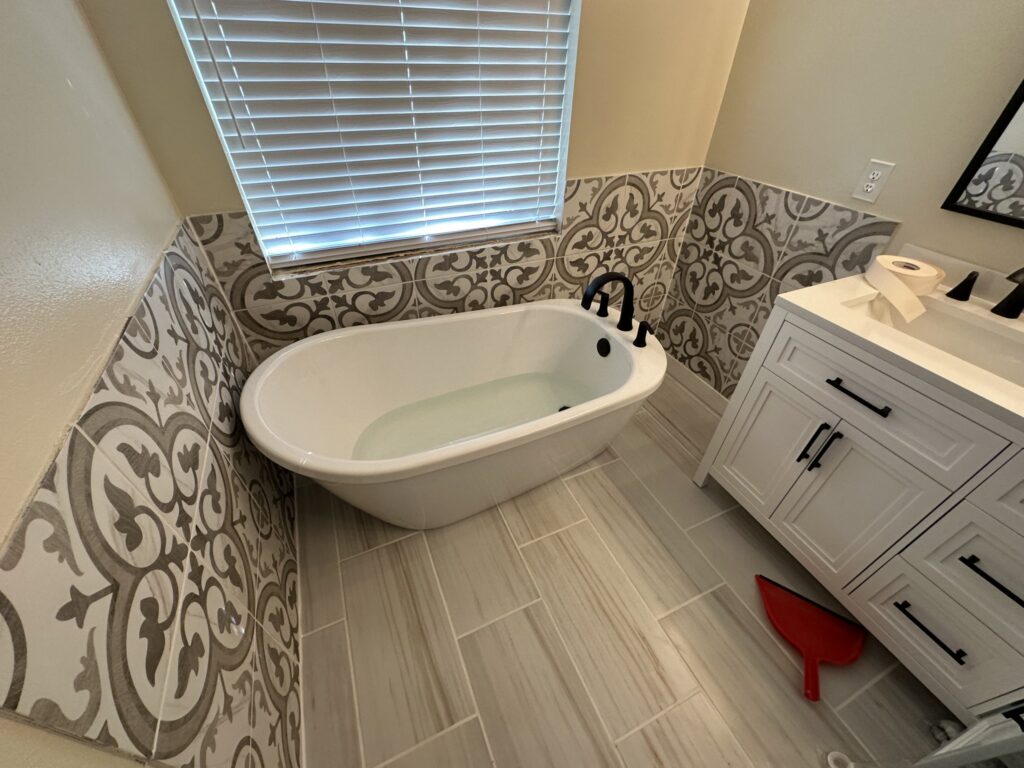
I go back to remodels a year later when the homeowner will let me, because a year of Palm Coast water tells me things about fixtures that the box never does. This master bath had been finished the previous fall: a rain head and a hand shower on a thermostatic valve, a matte-black widespread faucet on a double vanity, and a freestanding tub with a floor-mounted filler. The homeowner had three complaints, in order of annoyance, and a question about how to maintain new bathroom fixtures after a remodel so the list did not get longer. The complaints were a rain head spraying sideways, water spots on the black faucet that would not wipe off, and a tub filler diverter that took two hands.
This post is that check-in: what each problem was, which one was warranty and which two were water, the routine she uses now, and the finish advice I give before anyone picks fixtures.
What the water does, and why it is faster here
City water in Palm Coast runs about eleven grains per gallon of hardness according to the City of Palm Coast Annual Water Quality Report[1], which the USGS classification[2] puts at hard, near the top of the scale. Every drop that dries on a surface leaves calcium behind. On a rain head with dozens of small nozzles, that calcium builds inside the nozzles until some clog and the rest spray at angles. On a faucet, it leaves white spots that etch into the finish if they sit. The rate is the water’s; the tolerance is the finish’s.

Then the air. This house is in the Hammock, a mile from the ocean, and NOAA and Florida Sea Grant[3]‘s material on salt aerosol corrosion near the coast explains what happens: salt in the air settles on every exposed metal surface, holds moisture, and accelerates corrosion on anything that is not solid brass or stainless under its finish. A bathroom with a window that opens gets it faster. Inland Palm Coast gets less, but not none. Between the two, a fixture that would look new for five years in a soft-water inland city looks a year old in a year here.
Problem one: the rain head, which was scale
Twelve-inch rain head, about a third of the nozzles blocked, the rest spraying in a fan instead of straight down. Not a defect. I unscrewed it, dropped it in a bucket of white vinegar for an hour, worked the silicone nozzles with a thumb, and rinsed it. Every nozzle cleared. The fix is that simple and the maintenance is the same fix on a schedule: once a month, a bag of vinegar rubber-banded over the head for an hour, or the head off and in a bucket. Kohler’s[4] and Delta’s[5] fixture care guides both describe the vinegar soak and both say the same thing about harsh cleaners, which is that they strip the finish faster than they clear the scale. Vinegar and a thumb, monthly. A rain head that gets that treatment sprays straight for as long as the valve behind it lasts.
The hand shower needed the same soak. Hand showers are worse because they sit in a holder and drain slowly, so water dries inside them between uses.
Problem two: the spots on the black faucet, which was the finish
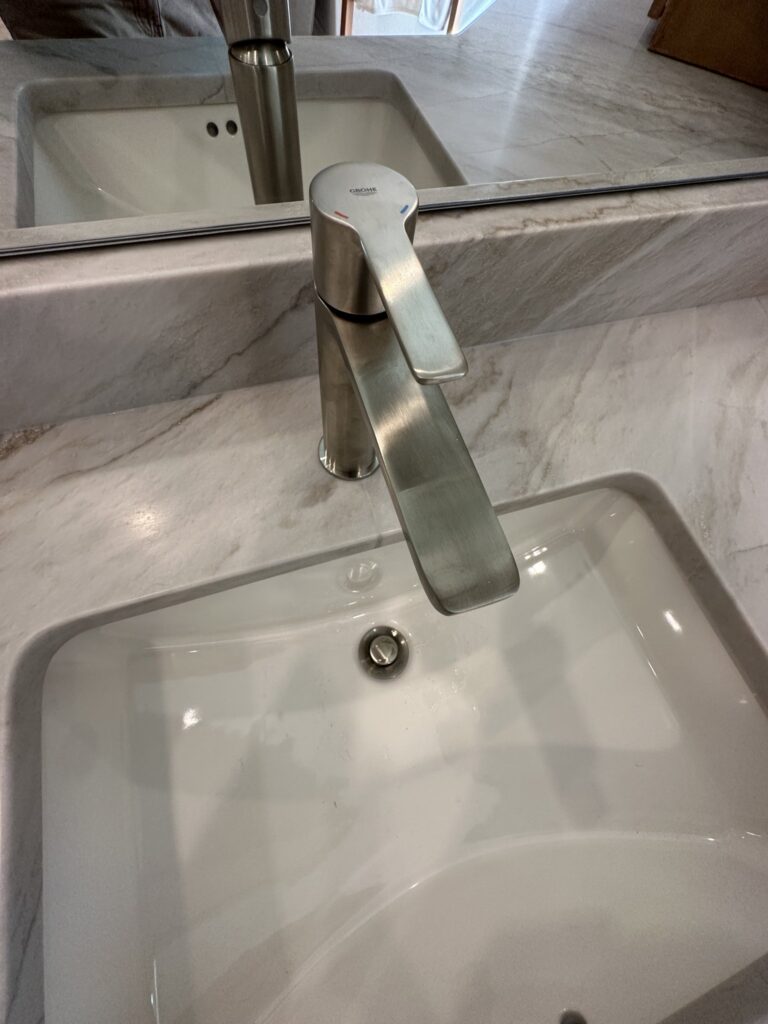
Matte black is a powder coat or a PVD finish over brass, and it shows every drop. The spots were mineral, not damage, and most came off with a soft cloth and a diluted vinegar wipe. A few had etched in where a drop had sat for days at the base of the spout, and those are permanent. This is not a defect either; it is what the finish does on this water. The care instructions on dark finishes say wipe dry after use, and in a household that actually does that they hold up. In most households they do not. I tell every customer choosing fixtures the same thing: chrome and brushed nickel forgive hard water and salt air because spots do not show and the finish is the metal; matte black, brushed brass, and oil-rubbed bronze show everything and depend on a coating. If you love the look, buy it knowing the towel is part of the fixture. She has a microfiber cloth on the vanity now and the spots have stopped. The EPA WaterSense[6] faucet aerators, which have a fine screen, also scale; those unscrew and soak with the rain head.
Problem three: the tub filler diverter, which was warranty
A floor-mounted tub filler with a hand shower has a diverter that sends water to one or the other. Hers had gotten stiff enough that she used two hands, and it was getting worse. That is not scale on the outside; it is the diverter cartridge inside the valve binding, and on a fixture a year old from a major brand it is a warranty part. I called it in, the manufacturer shipped a new cartridge, and I swapped it in ten minutes. If it had been scale, it would have been a soak. It was not, and the difference is the kind of thing a year-one visit is for: knowing which of the three complaints costs nothing and which one the manufacturer owes you.
The softener conversation
Every one of these problems traces to the water, and a whole-house softener removes most of the calcium before it reaches a fixture. She asked whether she should have put one in with the remodel. The honest answer: it would have prevented two of the three problems and most of what is coming, and it is a separate project with its own tradeoffs, including where it goes, the salt, and how it interacts with the irrigation. I gave her the short version and told her it is a decision about the whole house, not the bathroom, and that the bathroom will be fine either way with the monthly routine. She is thinking about it. Most people in the Hammock who remodel eventually do it.
The routine, written down
Monthly: vinegar soak on the rain head, hand shower, and faucet aerators. Weekly: wipe dark finishes dry after the last shower of the day, or accept the spots. Quarterly: run the tub filler diverter and every shut-off stop under the vanity through their full travel so nothing seizes; a valve that moves stays a valve that moves. Yearly: a look at the caulk lines, the toilet’s supply line, and the drain pop-ups, which scale too. Never: bleach-based or abrasive cleaners on any finish, and no scrub pads on matte or brushed metals. That list takes an hour a month. The fixtures it protects were a meaningful part of the remodel budget, and it is the difference between a bathroom that looks new at year five and one that looks tired at year two.
What people ask at the one-year mark
How do I clean a rain shower head with hard water? Vinegar soak, an hour, monthly. Work the nozzles with a thumb. No harsh cleaners.
Why does my new faucet have water spots? Eleven-grain water dries and leaves calcium. On dark finishes it shows and can etch. Wipe dry, or choose chrome or nickel.
Which finishes hold up best in Palm Coast? Chrome and brushed nickel. Dark and brass finishes need the towel habit.
Is scale covered under warranty? No, anywhere. Internal parts that bind or fail are, on the major brands, and they ship the part.
Should I get a water softener after a remodel? It would prevent most of this. It is a whole-house decision with its own tradeoffs, and worth a separate conversation.
Which fixtures to choose, and why choosing them before rough-in matters for the schedule, is the post on rough-in versus trim-out on a remodel that slipped three weeks, and the finish that backorders most is the one that spots most. The pull-down faucet in the island, on the same water, is in the post on kitchen island plumbing on a slab. The bathroom plumbing quote these fixtures sit on top of is the post on the calculator that said $3,000 and the quote that said $7,000, and the drain under this shower is the eighteen inches in the post on moving a shower drain on a Palm Coast slab. The remodel itself, from demo to trim-out, is the bathroom remodel plumbing guide.
What the bathroom looks like at year one, after the visit
The rain head sprays straight down. The faucet has a cloth beside it and no new spots. The tub filler diverts with one finger. Nothing about the remodel was wrong; it was built for water that is harder than the box assumed, and it needed an hour a month to stay ahead of that. It has it now.
If your remodel is a year old and the rain head is spraying sideways, that is the water, not the plumber, and the fix is a bucket of vinegar. For the diverter that takes two hands, or a plan to maintain new bathroom fixtures after a remodel before they get there, our remodel plumbing service in Palm Coast does the year-one visit under the $96 service call, applies it to any work, and handles the warranty call for you.