

Should I Repair or Replace a Water Heater That Just Tripped Its Breaker for the Third Time?
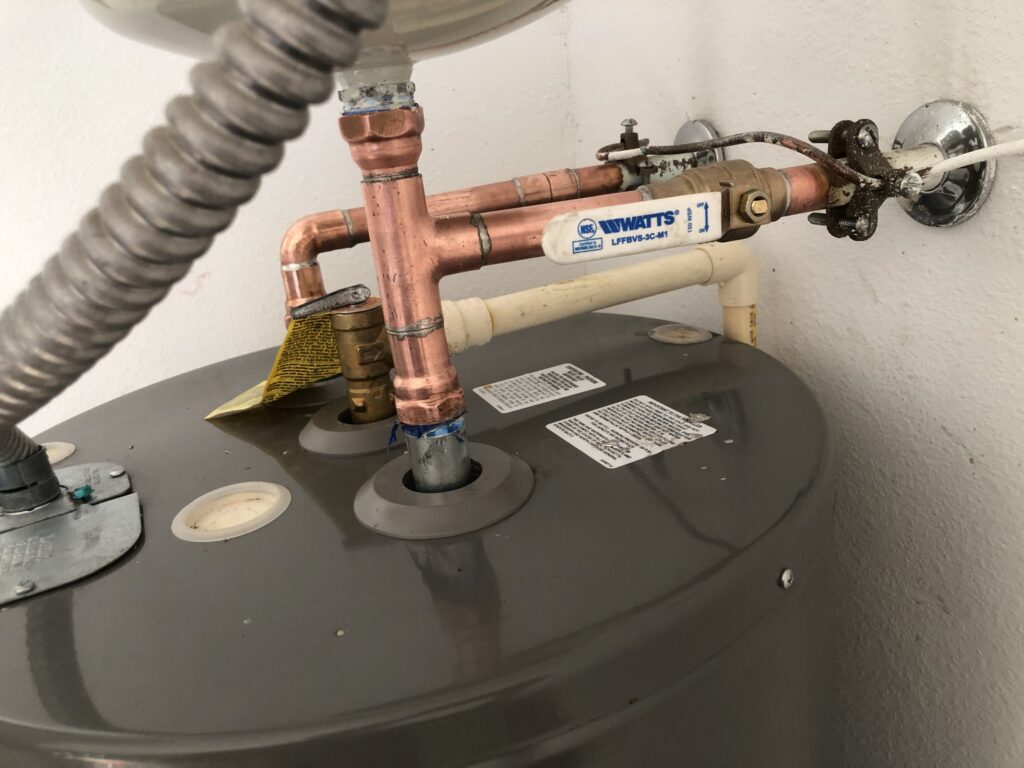
- A tripping breaker on an electric tank is usually a shorted element or a stuck thermostat. Both are cheap parts. Neither is the end of the tank.
- The age line I use: under seven years, repair almost always wins; over ten, replacement almost always wins; between them, the anode and the pan decide.
- On this six-year-old tank the elements were fine. The pan was not, and that changed the recommendation.
- A warranty tank changes the math. Check the rating plate before you assume you are paying for the whole thing.
The situations described here are composites drawn from the types of jobs and decisions we encounter regularly. Names and specific figures are illustrative.
The call came from a house off Palm Harbor Parkway on a Tuesday. The water heater breaker had tripped Sunday, again Monday, and again that morning, and the homeowner had reset it each time and gotten a few hours of hot water. He wanted to know whether he should repair or replace a water heater that was only six years old. Six years is young. My answer on the phone was that it was almost certainly a part, not the tank, and that I would know within twenty minutes of arriving. I was right about the first half.
This post is that visit, in order, because the order is how you get to the right answer without buying a heater you did not need or patching one that was already finished.
What a tripping breaker usually means on an electric tank
An electric water heater has two 4,500-watt elements and two thermostats, upper and lower, wired so only one element runs at a time. The circuit is a dedicated 30-amp, 240-volt breaker with 10-gauge wire, which is what NFPA 70[1] Article 422 calls for. A breaker that trips under normal load means something is drawing more than it should or shorting. Three suspects, in order of likelihood: an element whose sheath has cracked and is shorting to the tank, a thermostat stuck closed that lets an element run past its cutoff, or a loose connection in the junction box that is arcing.
None of those is a tank problem. Elements and thermostats are parts that thread or clip in, and on a tank with a clean interior they are a routine repair. The homeowner had already read enough to know that, which is why he called instead of buying a heater at the big-box store.
Breaker off, cover off, meter out
First step is the same one I walk people through on the phone when a tank is leaking, which I wrote up in the post about a Saturday puddle under a Palm Coast garage water heater: kill the breaker before touching anything. Then I pulled both access covers, folded back the insulation, and put a meter across each element with the wires disconnected. The upper element read about 13 ohms, which is right for a 4,500-watt element at 240 volts. The lower element read the same. Then I checked each element from its terminals to the tank body, which is the test for a short. Both read open. The elements were fine.

The thermostats were next. The upper thermostat has a high-limit reset button, the red one, and it had not tripped, which told me the tank was not overheating. Both thermostats clicked cleanly and showed continuity where they should. Fine. That left the junction box on top, and there was the first real finding: the neutral had never been landed properly, and one of the hot conductors was loose enough to turn with my fingers. There was scorch on the wire nut. A loose 240-volt connection under a 4,500-watt load arcs, heats, and eventually trips the breaker, and it gets worse each time. That was the breaker problem. Ten minutes to clean the conductors and reconnect with new nuts.
If the visit had ended there, it would have been a $96 service call applied to a small repair, which is what our plumbing repair service in Palm Coast does all week. It did not end there.
The pan
I always look in the pan before I put the covers back on, because a pan tells you what the tank is not saying. This one had a dried ring of rust flakes around the drain valve side and a damp patch under the T&P discharge. I ran the drain valve into a bucket: the first pull came out orange with sediment, and there was a rasp in the flow that means scale chunks. Then I pulled the cold inlet nipple to check the dip tube, because a six-year-old tank running out of hot water faster than it used to, which he had mentioned in passing, is a dip tube symptom. The dip tube was cracked two-thirds of the way down. Cold water was entering the top of the tank instead of the bottom and mixing straight into the hot outlet.
So the breaker was a connection. The hot water running out was a dip tube. And the rust in the pan was the tank telling me the lining had started to go. Six years is early for that on soft water. On Palm Coast city water, which the City of Palm Coast Annual Water Quality Report[2] and the USGS classification[3] put in the hard to very hard range, and with an anode I pulled and found nearly consumed, it is early but not unheard of. I go into why in the post on how long water heaters last in Florida.
The conversation on the driveway
Here is how I lay out the decision, and how I laid it out for him. Under seven years, I repair almost every time. The tank has life left, the parts are cheap, and a new anode buys years. Over ten years, I replace almost every time, because parts money spent on a tank in its last quarter is money you spend twice. Between seven and ten, two things decide it: what the anode looks like and what the pan looks like. Rust flakes in the pan with a consumed anode means the corrosion clock is running regardless of age.
His tank was six years old with a consumed anode and rust in the pan. The repair path was a dip tube, a new anode, and the connection fix, about $300 in parts and labor on top of the service call. That would have bought him hot water for a while. It would not have stopped a tank that had already started to rust from the inside. My honest estimate was two to four more years, and the risk that it ends the way the Saturday-puddle tank did, with wet drywall.
Then I looked at the rating plate more carefully. The tank carried a nine-year manufacturer warranty. Rheem[4], A.O. Smith[5] and Bradford White[6] all sell tiers with six, nine, and twelve-year tank warranties, and the warranty applies to a leaking tank from a lining failure, not to elements or thermostats. His had three years left. That changed the recommendation: replace it now under warranty and pay for labor and the parts the warranty does not cover, rather than repair it and hope the leak waits until the warranty is gone.
What we did, and what it cost him
He filed the warranty claim with the model and serial from the plate and a photo of the pan. The manufacturer authorized a replacement tank at no charge for the unit. We installed it the following week on a new pan with a drain line, added the thermal expansion tank the house had never had, which the Florida Building Code, Plumbing edition[7], requires where a check valve or pressure-reducing valve closes the system, and landed the electrical properly. His out-of-pocket was labor, the pan, the expansion tank, and the permit. Less than the repair-plus-replacement path would have cost him in three years, and no puddle.
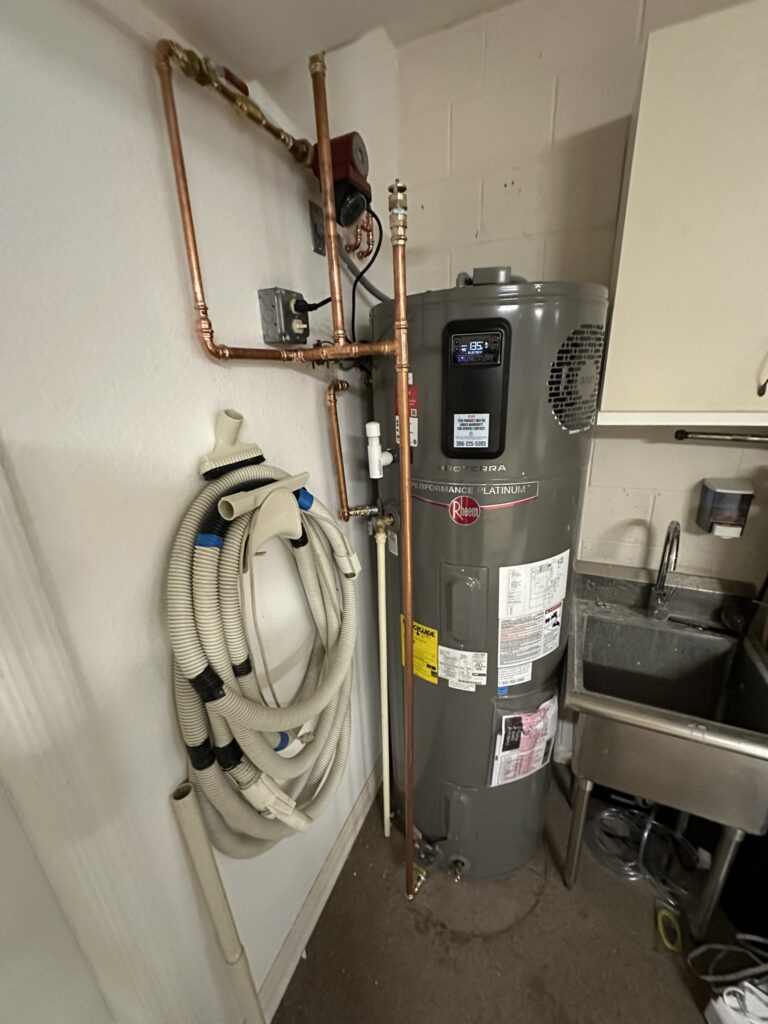
I mention the permit because people are surprised by it. A water heater replacement in Palm Coast pulls a plumbing permit and gets an inspection, and it is on the line-item quote I send. I break that quote down in the post on what an itemized water heater quote in Palm Coast actually includes.
What people ask at this point in the visit
Is it worth repairing or replacing? Under seven years with a clean pan, repair. Over ten, replace. In between, the anode and the pan decide, and a warranty on the tank can tip it toward replacement earlier than you would expect.
How much does it cost to replace an element? It is one of the cheaper water heater repairs, a part and about an hour, applied against the service call. A thermostat is similar. A dip tube is a little more because the inlet has to come apart.
Why does my electric water heater have no hot water at all? Tripped breaker, tripped high-limit reset, failed upper element, or failed upper thermostat, in that order. The upper element does all the work first, so when it fails you get nothing.
When is a water heater not worth fixing? When the tank body is leaking, when the anode is gone and the pan shows rust on a tank past ten, or when the repair costs more than a third of a replacement on a tank past eight.
He also asked, once replacement was on the table, whether to look at a hybrid or tankless instead of another standard tank. The garage answered that: a closet install with no clearance, so a standard tank it was. I go through both alternatives in the posts on whether a heat pump water heater is worth it in Florida and tankless versus tank in an all-electric Palm Coast home, and the whole decision tree is in the full guide built from one week of Palm Coast water heater calls.
What that Tuesday changed about how I answer the phone
I still tell people a tripping breaker is almost certainly a part. It usually is. But I no longer stop at the part. The pan and the anode take five extra minutes and they are the difference between a repair that holds and a repair that just delays the Saturday call. The homeowner asked me afterward whether he should have known. He could not have. The tank looked fine from the outside. That is why the check exists.
If you are trying to decide whether to repair or replace a water heater, the visit starts the same way every time: breaker, meter, pan, anode, rating plate. Our water heater installation and repair service in Palm Coast does that check as part of the service call, and the $96 applies to whichever path you choose.
Sources
- NFPA 70, National Electrical Code, Article 422
- City of Palm Coast Annual Water Quality Report (Consumer Confidence Report)
- USGS Water Science School: Hardness of Water
- Rheem: water heater manuals and serial-number date codes
- A. O. Smith: water heater serial-number date codes
- Bradford White: water heater serial-number date codes
- Florida Building Code, Plumbing (8th Edition, 2023), Florida Building Commission